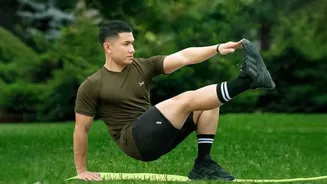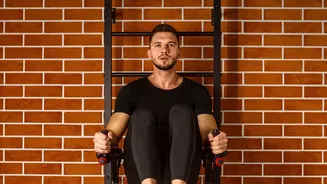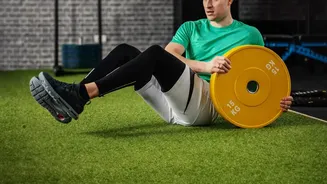

Beyond the Six-Pack: What is Functional Power?
Before diving into the exercises, it’s important to understand what 'functional' core strength means. It’s not just about visible abs. A functional core involves a deep network of muscles—including your rectus abdominis, obliques, and transverse abdominis—working
together to stabilize your spine and pelvis. This translates directly to real-world activities: lifting groceries, maintaining good posture at your desk, playing with your kids, or generating power in sports. The goal is to build a core that provides a solid foundation for every move you make, reducing the risk of pain and injury.
The Plank: Your Foundation for Stability
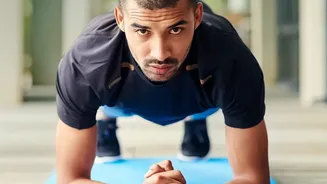
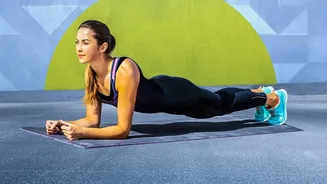
The plank is a powerhouse of an exercise because it’s isometric, meaning you engage the muscles without movement, which is fantastic for building raw stability. It strengthens your entire core, shoulders, and back, teaching your body to maintain a rigid, straight line.How to do it: Lie face down and prop yourself up on your forearms, with your elbows directly under your shoulders. Lift your hips so your body forms a straight line from your head to your heels. Avoid letting your hips sag or rise too high.The Hack: Engage your core by imagining you are pulling your belly button up towards your spine. Squeeze your glutes and quads to create full-body tension. This simple mental cue ensures maximum muscle activation.
The Dead Bug: Master of Control
The Dead Bug might have a strange name, but it is one of the best exercises for developing coordinated core control and stability. It teaches your core to resist extension and rotation while your limbs are in motion, a key function for protecting your lower back.How to do it: Lie on your back with your arms extended toward the ceiling. Lift your legs so your knees are bent at a 90-degree angle directly over your hips. Slowly lower your right arm and left leg toward the floor simultaneously, stopping just before they touch. Return to the start with control and repeat on the other side.The Hack: The key is to move slowly and deliberately. Press your lower back firmly into the floor throughout the movement. If your back starts to arch, you’ve lowered your limbs too far. Reduce the range of motion until you can maintain a flat back.
The Bird-Dog: Building Balance and Strength
Like the Dead Bug, the Bird-Dog challenges your core to remain stable while your limbs move. It’s excellent for improving balance and strengthening the muscles along your spine and your glutes. This move enhances coordination between the upper and lower body.How to do it: Start on all fours, with your hands directly under your shoulders and your knees under your hips. Keep your back flat and neck in line with your spine. Extend your right arm straight forward and your left leg straight back, keeping your hips and shoulders square to the floor. Hold for a moment, then return to the starting position. Repeat on the other side.The Hack: Imagine you have a glass of water balanced on your lower back. Your goal is to complete the movement without spilling it. This visualization helps prevent your hips from rotating and ensures your core is doing the stabilization work.
The Glute Bridge: Powering Your Posterior Chain
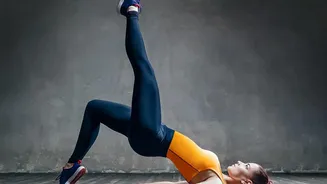
While you might think of this as a glute exercise, the bridge is a fantastic functional movement for your entire core. It activates the glutes and hamstrings, which are crucial partners to your abdominals in supporting your pelvis and lower back. A strong posterior chain is essential for preventing lower back pain.How to do it: Lie on your back with your knees bent, feet flat on the floor about hip-width apart, and your arms by your sides. Squeeze your glutes and engage your core, then lift your hips off the floor until your body forms a straight line from your shoulders to your knees. Hold for a second at the top before slowly lowering back down.The Hack: To ensure your glutes are doing the work, press through your heels. At the top of the bridge, focus on squeezing your glutes as hard as you can, rather than arching your lower back to gain height.