


The Universe's Missing Link
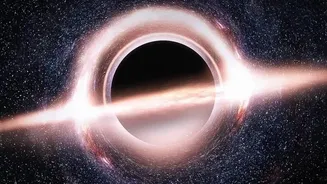
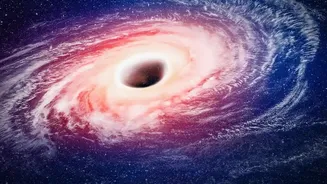
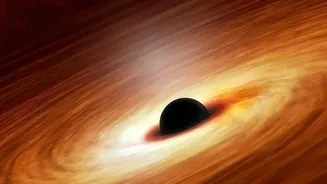
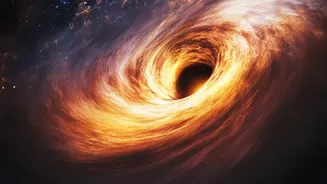
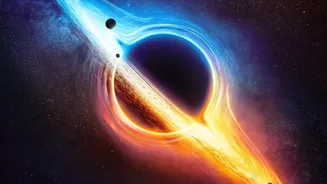
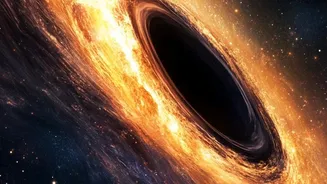
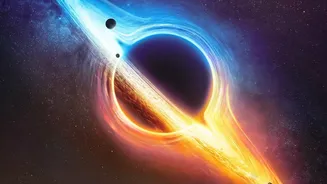
In the cosmic zoo of black holes, astronomers have long been familiar with two main types: the 'stellar-mass' variety, which are up to about 100 times the mass of our sun, and the 'supermassive' behemoths that sit at the centre of galaxies, weighing millions
or even billions of suns. But between these two extremes lies a mysterious gap populated by the so-called 'intermediate-mass' black holes (IMBHs). These objects have been notoriously hard to find, making them a missing link in our understanding of how supermassive black holes grow. Finding them is one thing; understanding how they behave is another challenge entirely. They are the key to unlocking the story of galaxy evolution.
Listening to a Cosmic Crash
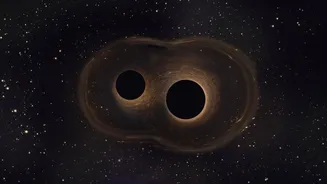
Detecting these cosmic collisions relies on gravitational waves—minuscule ripples in the fabric of spacetime itself, first predicted by Albert Einstein. Observatories like LIGO in the United States, Virgo in Italy, and KAGRA in Japan act like giant ears, listening for the faint 'chirp' signal produced when two massive objects merge. Recent detections have captured the merger of two IMBHs with stunning clarity. This is not just any collision; the high quality of the data is allowing scientists to move beyond simply detecting the event and into dissecting the precise mechanics of the collision itself. By analysing the shape of the wave, they can infer properties like the mass and, crucially, the spin of the black holes just before they merged.
The Secrets of Spin
One of the most revealing new details concerns the spin of the merging black holes. Recent observations suggest that in some IMBH collisions, one of the black holes is spinning incredibly fast while its partner is almost stationary. This is a tell-tale sign of a 'hierarchical merger'. The theory suggests the fast-spinning black hole is a 'second-generation' object, itself born from a previous collision. A black hole formed from a star's collapse tends to have little spin. But when two black holes merge, their momentum sends the new, larger object spinning rapidly. Finding a high-spin black hole paired with a low-spin one provides powerful evidence for this cycle of repeated mergers, a key mechanism for building up mass in the universe.
A Post-Merger 'Kick'
The insights don't stop at the collision. The new data also gives scientists a detailed look at the aftermath. When two black holes of unequal mass or spin merge, the collision is not perfectly symmetrical. This asymmetry results in a powerful 'kick' of gravitational waves being blasted in one direction, causing the newly formed, larger black hole to recoil in the opposite direction, like a fired cannon. Detailed analysis of the gravitational wave signal allows researchers to calculate the speed of this kick. Observing this phenomenon in an IMBH merger provides crucial data for models that explain how these objects might be ejected from the dense star clusters where they are thought to form, sending them wandering through their host galaxies.
India's Ear to the Cosmos
This new era of gravitational-wave astronomy has a strong connection to India. Indian scientists are integral members of the LIGO collaboration, contributing significantly to data analysis and the interpretation of these cosmic events. Furthermore, the country is set to become a major hub for this research with the construction of the LIGO-India observatory in Maharashtra. Having recently broken ground, the facility will join the global network of detectors, dramatically improving our ability to pinpoint the exact location of these mergers in the sky. This enhanced precision is critical for enabling conventional telescopes to look for any light associated with the merger, ushering in an age of 'multi-messenger astronomy' and giving us a more complete picture of the universe's most violent events.