






The Problem of Sheer Scale
First, consider the search area: space is unimaginably vast. Finding a small asteroid is often compared to finding a specific dark lump of coal in a pitch-black, country-sized field. Astronomers find near-Earth objects (NEOs) by taking sequences of images
of the sky and looking for faint dots that move against the background of stationary stars. But even our most powerful telescopes can only survey a fraction of the sky at any given time. While we've gotten good at finding the huge, "planet-killer" asteroids larger than a kilometer wide, there are an estimated 25,000 NEOs larger than 140 meters—big enough to cause regional devastation—and we have only found a fraction of them.
Size and Darkness
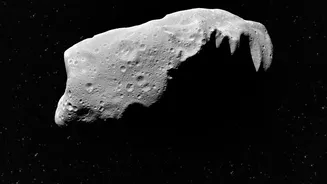
Many asteroids are fundamentally difficult to see. It's not just that they're small; they are also incredibly dark. Asteroids don't produce their own light; we only see them because they reflect sunlight. An asteroid's reflectivity is called its albedo, and many have a very low albedo, meaning they are as dark as charcoal. A large, dark asteroid can appear just as faint as a small, shiny one, making it difficult for astronomers using visible light telescopes to accurately judge an object's true size from its brightness alone. Infrared telescopes are better at determining size because they detect the heat an asteroid emits, which is more directly related to its mass. However, the smaller the object, the fainter its reflected light and heat signature, making detection a serious challenge.
Hiding in the Sun’s Glare
One of the biggest blind spots in our planetary defense is the Sun itself. Ground-based telescopes can only scan the night sky. Any asteroid approaching Earth from the direction of the sun is effectively masked by its brilliant glare. This is not a hypothetical problem; the Chelyabinsk meteor came from the sunward direction, which is why it went completely undetected. To protect sensitive optics, major space telescopes like Hubble and James Webb are generally pointed away from the Sun. This creates a significant gap in our search. Recently, astronomers have begun dedicated "twilight" surveys, scanning the sky just before sunrise and after sunset to find these hidden threats, leading to the discovery of several previously unknown asteroids, including some with orbits entirely inside Earth's.
Speed and Trajectory
Near-Earth asteroids are not leisurely wanderers; they are fast. By the time a small asteroid is close enough to Earth to be bright enough for easy detection, it can be moving across the sky at an incredible angular velocity. This makes it hard to track and requires rapid coordination between observatories to confirm its path. Furthermore, their orbits can be unpredictable. Gravitational nudges from planets can alter an asteroid's path over time, meaning even known objects require continuous observation to ensure their trajectories remain safe. The combination of high speed and a relatively small detection window means that for some objects, our warning time could be very short.
A Brighter Future for Detection
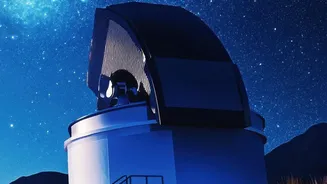
While the challenges are significant, our ability to find these hidden rocks is rapidly improving. Survey programs like the Catalina Sky Survey and Pan-STARRS have discovered thousands of NEOs. The next generation of technology promises to revolutionize the field. The Vera C. Rubin Observatory, set to begin its full survey soon, is expected to find millions of new asteroids. It will scan the entire southern sky every few nights with unprecedented sensitivity, allowing it to spot fainter and more distant objects than ever before. Even in its preliminary testing phases, Rubin has already discovered thousands of new asteroids. In addition, space-based infrared telescopes like the planned NEOMIR mission will be positioned to specifically hunt for asteroids in the Sun's glare, filling that critical observational gap.