


The Old 'Goldilocks' Rule
For decades, the search for habitable planets has been guided by the 'habitable zone,' often called the 'Goldilocks zone.' The idea is simple: a planet shouldn't be too close to its star (too hot) or too far away (too cold). It needs to be in that perfect
orbital range where temperatures could allow liquid water to exist on the surface, a key ingredient for life as we know it. This concept has been a useful first filter, helping astronomers prioritise which of the thousands of known exoplanets are most interesting. However, scientists have long suspected that this was only part of the story. A planet's location is one thing, but its ability to hold onto the very conditions that make it habitable is another, far more complex issue.
A Star's Hidden Danger
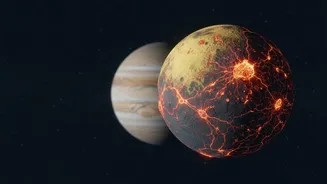
A star gives life with its warmth, but it can also take it away. Stars, particularly the common but volatile M-dwarf stars, blast out intense radiation and stellar winds. For planets orbiting very close to their parent star, this constant bombardment can be powerful enough to literally strip away their atmosphere over millions of years. This process is called atmospheric escape or stripping. Without a protective atmosphere, any surface water would boil away, and the world would be exposed to deadly radiation, rendering it barren. This means a planet could be in the perfect Goldilocks temperature zone but still be completely uninhabitable because its star has scoured its atmosphere away, leaving behind a bare rock. Until recently, observing this process in action on distant worlds was incredibly challenging.
JWST's Powerful Gaze Changes the Game
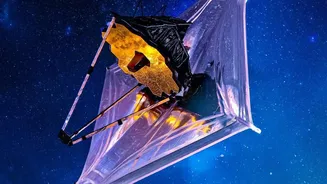
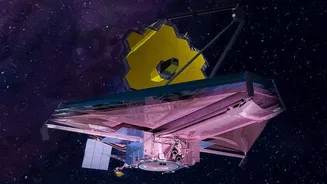
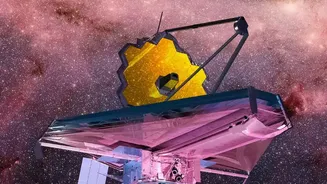
Enter the James Webb Space Telescope. With its unparalleled sensitivity to infrared light, JWST can do something revolutionary: analyse the chemical makeup of distant exoplanet atmospheres. As a planet passes in front of its star from our perspective, a tiny fraction of starlight filters through its atmosphere. Different gases absorb specific wavelengths of light, leaving a unique chemical fingerprint that the telescope can read. By studying what's missing from the starlight, scientists can determine what molecules like water, methane, or carbon dioxide are present. This technique, known as transmission spectroscopy, has given us an unprecedented ability to not just find planets, but to begin to understand their weather and chemistry.
The Crucial Link: Orbit and Atmosphere
JWST's observations are now drawing a clear and dramatic line connecting a planet's orbital distance to the fate of its atmosphere. For instance, studies of planets in systems like TRAPPIST-1, which orbits a cool M-dwarf star, have been revealing. Observations of the innermost planets, which are subjected to the most intense radiation, suggest they lack significant atmospheres. Conversely, the search continues for robust atmospheres on planets further out. JWST has also observed dramatic atmospheric escape in real-time. On the 'super-puff' exoplanet WASP-107b, which orbits its star very closely, the telescope witnessed a massive cloud of helium gas being violently stripped away, stretching for enormous distances into space. This direct evidence shows that proximity to a star is a key factor in whether a planet can maintain its atmospheric blanket.
Redefining the Search for Life
This new wealth of data is forcing a major refinement of our definition of a habitable planet. It’s no longer enough for a world to simply be in the right temperature zone. It must also be in a 'safe' zone where it can successfully hold onto its atmosphere against the onslaught of its parent star. This adds a critical new layer to our models of planetary habitability. Some planets once considered promising candidates might now be seen as less likely to host life due to their perilous proximity to their stars. Paradoxically, some studies have also found evidence of atmospheres on ultra-hot worlds where none were expected to survive, challenging models and showing the process is complex. These findings are not a setback; they represent a significant leap forward, allowing scientists to be much more efficient and targeted in their search.