

A Cat Video from the Cosmos
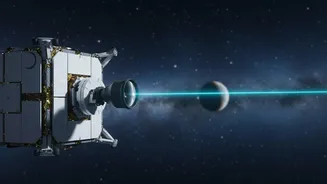
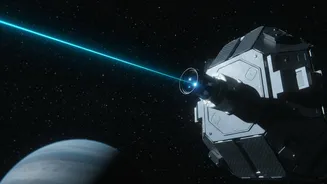
In a remarkable demonstration, NASA's Deep Space Optical Communications (DSOC) experiment transmitted a 15-second, ultra-high-definition video back to Earth. The star of the video was a charming orange tabby cat named Taters, seen playfully chasing a laser
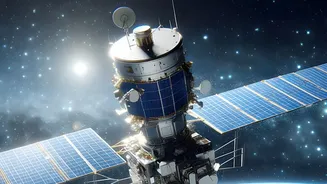
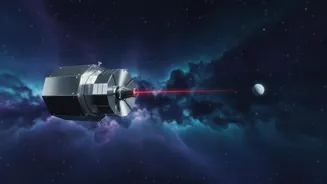
dot. This transmission wasn't from a nearby satellite; it was sent from the Psyche spacecraft, which was approximately 19 million miles (or 31 million kilometres) away at the time — about 80 times the distance between the Earth and the Moon. The video signal, encoded in a near-infrared laser, took just 101 seconds to travel across the void of space before being received by the Hale Telescope at Caltech’s Palomar Observatory in California. While sending a cat video might seem whimsical, the choice was a nod to history, reminiscent of early television test broadcasts that also featured a feline figure.
How Lasers Outpace Radio Waves
For decades, space missions have relied on radio frequency (RF) communications to send data back home. Think of radio waves like the spray from a wide-nozzle garden hose — they spread out significantly over long distances. This dispersion means the signal becomes weaker, limiting the amount of data that can be sent at once. Lasers, on the other hand, are like a highly focused jet of water. The technology, known as optical communication, uses light, specifically near-infrared lasers, to encode and transmit information. Because the laser beam is much more concentrated, it can carry far more data over the same distance, much like how fibre optic cables on Earth use light to provide high-speed internet. This allows for data rates that are 10 to 100 times greater than the most advanced radio systems currently used by NASA.
Faster Than Your Home Internet
The Taters video wasn't just a proof of concept; it was a demonstration of incredible speed. The data was transmitted at a maximum rate of 267 megabits per second (Mbps). To put that in perspective, that's faster than many home broadband internet connections. This breakthrough solves a major bottleneck for space exploration. As scientific instruments on spacecraft become more powerful, they collect vast amounts of high-resolution images and data. Traditional radio systems have struggled to send all this information back to Earth efficiently, sometimes forcing scientists to wait weeks or months for a complete dataset. With laser communications, transmitting a full map of Mars could potentially take nine days instead of nine weeks. This speed allows scientists to spend more time analysing data and less time waiting for it to arrive.
The Future of Interplanetary Connectivity
This successful test is a critical step towards building a reliable, high-speed internet connection across the solar system. The immediate application is for future missions to the Moon and Mars. The technology will enable high-definition video streaming from the Martian surface, allowing scientists and the public to experience exploration in near real-time. For astronauts, it means the possibility of two-way video calls with loved ones on Earth, a vital link for long-duration missions. Beyond communication, the system itself offers other advantages. Laser communication hardware is generally smaller, lighter, and requires less power than comparable radio systems. This frees up valuable mass and energy on a spacecraft for more scientific instruments, making missions more efficient and cost-effective. The narrowness of the laser beam also makes it inherently more secure and harder to intercept than a broad radio signal.