





A New Kind of Explorer
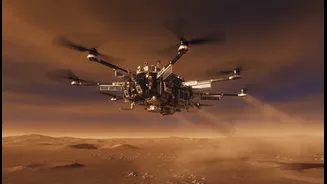
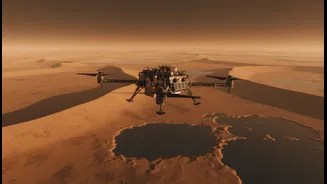
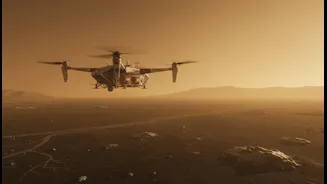
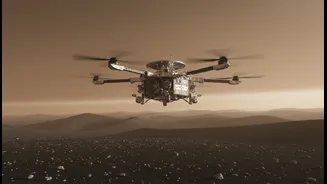
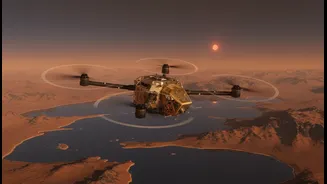
For decades, our robotic exploration of other worlds has been limited to orbiters, stationary landers, or wheeled rovers. Dragonfly represents a paradigm shift. It’s an octocopter—a drone with eight rotors—designed to be a relocatable lander. This means
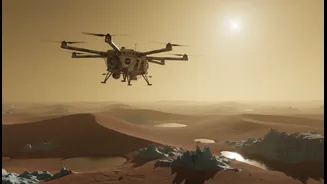
it won't be confined to a single landing site. Instead, it will fly from one point of interest to another, covering kilometers in a single hop that would take a rover months or years to traverse. Scheduled for launch in July 2028, this ambitious mission will send its sophisticated craft on a long journey, arriving at Titan in 2034. Its goal is to become the first vehicle to perform powered, controlled flight on another moon, fundamentally changing how we conduct planetary science.
Destination: A Bizarrely Earth-Like World
Titan is one of the most intriguing bodies in our solar system. It's the only moon with a dense atmosphere, even thicker than Earth's, and a weather system complete with clouds, wind, and rain. But on Titan, it rains liquid methane and ethane, which carve rivers and fill vast lakes and seas. This unique environment, with its low gravity (about one-seventh of Earth's) and thick air, makes it surprisingly ideal for flight. Despite its frigid surface temperature of around -179°C, Titan is considered a prebiotic chemistry lab. Its atmosphere is rich in complex organic molecules that rain down on a surface made of water ice as hard as rock and dunes of hydrocarbon sand, creating a potential primordial soup.
The Science Lab on Wings
Dragonfly is much more than a drone; it's a fully-equipped laboratory. Its main purpose is to investigate Titan's habitability and study the building blocks of life. To do this, it carries a sophisticated suite of instruments. The Drill for Acquisition of Complex Organics (DrACO) will collect samples from the surface, which are then fed into the Dragonfly Mass Spectrometer (DraMS). This instrument, similar to one on the Mars Curiosity rover, will analyze the chemical composition of the samples to search for complex organic molecules, such as amino acids. Meanwhile, the Dragonfly Gamma-Ray and Neutron Spectrometer (DraGNS) will measure the composition of the ground beneath the lander. A camera suite (DragonCam) and meteorology sensors will provide stunning images and monitor atmospheric conditions, while a seismometer will listen for "Titanquakes" to study the moon's interior.
How It Will Fly and Survive
Flying on a world over a billion kilometers away requires incredible autonomy. With a round-trip communication delay of up to 2.5 hours, Dragonfly can't be 'flown' from Earth. It will make its own decisions about navigation and landing. The plan is for Dragonfly to perform flights lasting about half an hour, once every one or two Titan days (a Titan day is 16 Earth days). Between flights, it will spend most of its time on the ground, analyzing samples and recharging its batteries. Since Titan is too far from the Sun for solar power to be effective, Dragonfly will be powered by a Multi-Mission Radioisotope Thermoelectric Generator (MMRTG), which converts heat from decaying plutonium into electricity, the same technology that powers the Curiosity and Perseverance rovers on Mars.
The Search for Life's Origins
Dragonfly's first landing site will be the Shangri-La dune fields near Titan's equator, an area that resembles the Namib Desert on Earth. From there, it will hop toward the Selk impact crater, a site where scientists believe heat from the impact may have melted water ice, creating a temporary environment where organic molecules and liquid water could have mixed. While the mission isn't designed to find living organisms, it's hunting for chemical biosignatures—evidence that the conditions for life may exist, or once existed. By studying the complex chemistry on Titan, scientists hope to get a glimpse into the processes that may have led to the origin of life on our own planet, a story whose earliest chapters have been erased from Earth's geologic record.