



Earth's Frozen Time Capsule
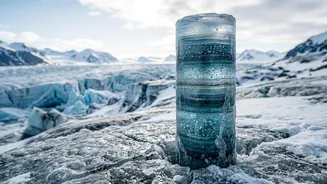
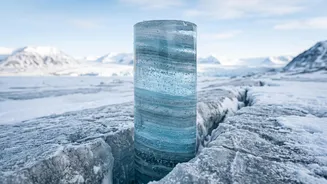
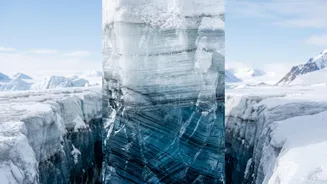
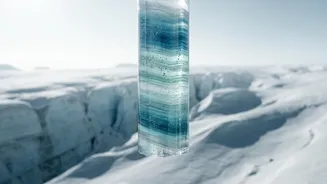
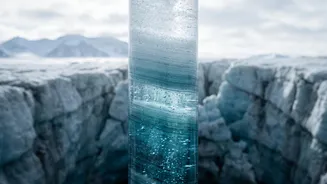
In the vast, frozen expanse of Antarctica, it snows, but the snow never melts. Year after year, century after century, new layers fall, compressing the old ones beneath them into solid ice. This process creates a layered timeline, much like the rings
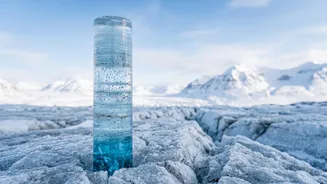
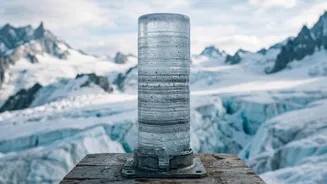
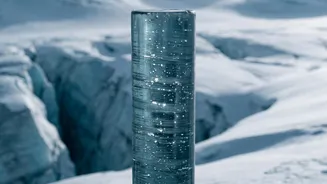
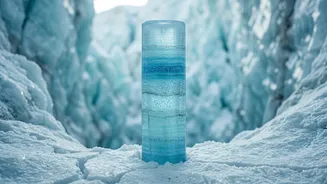
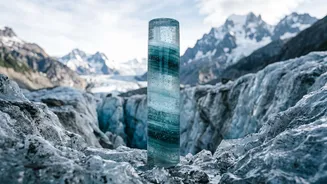
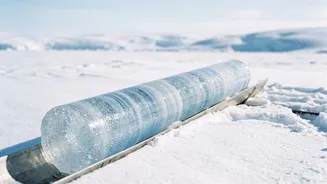
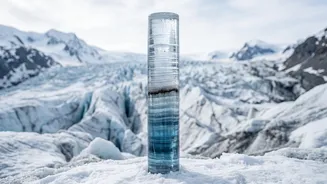
of a tree, stretching down for kilometres. The immense ice sheets of East Antarctica are particularly stable, allowing for an unbroken record. The longest continuous ice cores drilled there extend more than three kilometres deep, capturing an astonishing 800,000 years of climate history. These cylinders of ice are, in effect, time capsules, preserving invaluable information about the planet's past environment.
The Delicate Art of Drilling
Extracting this ancient ice is a monumental feat of engineering and logistics. International teams of scientists establish camps in some of the most remote and inhospitable places on Earth. Using specialised drills, they carefully bore into the ice sheet, pulling up cylindrical sections of ice, typically a metre long at a time. Projects like the European Project for Ice Coring in Antarctica (EPICA) have been instrumental. A more recent effort, the 'Beyond EPICA' project, successfully drilled over 2.8 kilometres by early 2026, aiming to retrieve ice that is even older—potentially up to 1.5 million years—to solve mysteries about shifts in Earth's ice age cycles. These precious cores are then meticulously catalogued and transported in a frozen state to laboratories around the world for analysis.
Ancient Air Trapped in Bubbles
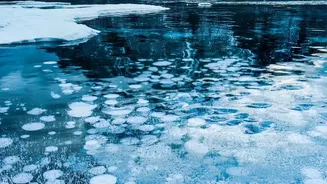
The most critical secrets are held in what the ice contains: tiny, trapped bubbles of air. As the surface snow is compacted into dense 'firn' and then into solid ice, pockets of the surrounding atmosphere are sealed off. These bubbles are pristine samples of Earth's past atmosphere, locked away for millennia. To analyse them, scientists place sections of the ice core into a vacuum chamber and either crush or gently melt the ice, releasing the ancient air. This allows for direct measurement of the atmospheric composition from the very moment that ice was formed, providing a concrete record rather than an indirect estimate.
How Scientists Read the Past
Scientists use an array of sophisticated techniques to read the stories in the ice. To determine the age at different depths, they can count the visible annual layers in the upper sections. For deeper ice, where layers are compressed, they rely on mathematical models of ice flow and by identifying layers of volcanic ash that can be cross-referenced with other geological records. To reconstruct past temperatures, they analyse the ratio of different water isotopes (types of oxygen and hydrogen atoms) in the ice itself. Air bubbles are analysed with mass spectrometers to measure the precise concentrations of greenhouse gases like carbon dioxide (CO2) and methane, providing a direct link between atmospheric composition and temperature over hundreds of thousands of years.
An 800,000-Year Perspective on Climate
The 800,000-year record from Antarctic ice cores has been revolutionary for climate science. It revealed a clear history of Earth's natural climate cycles, showing long, cold 'glacial' periods interspersed with warmer 'interglacial' periods roughly every 100,000 years. Crucially, this data provides undeniable evidence of the powerful link between greenhouse gas concentrations and global temperature. This long-term perspective shows that while CO2 levels naturally fluctuated between about 180 and 300 parts per million over these vast cycles, they began to rise sharply in the 19th century. The current concentration is nearly 40% higher than at any point in the 800,000-year ice core record, and the rate of this increase is unprecedented.