


Setting the Stage: A Cosmic Transit
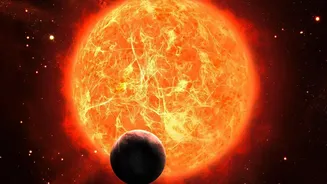
The whole process begins with an event called a 'transit'. This happens when a distant planet, or exoplanet, passes directly between its star and our telescope. From our perspective, the planet creates a mini-eclipse, causing a tiny, temporary dip in the star's
brightness. While we can't see the planet itself, this dimming of starlight is the crucial first clue. It confirms the planet's presence and orbital timing. For scientists, this predictable celestial alignment is like a starting pistol, signaling that the exoplanet's atmosphere is about to be briefly backlit and ready for analysis. This transit method is the foundation upon which our understanding of alien atmospheres is built.
Starlight as a Sieve
As the exoplanet transits its star, a sliver of starlight filters through the very edge of the planet's atmosphere. This is where the magic really happens. The gases in that atmosphere act like a selective filter or a sieve. Just as a red piece of glass absorbs all colors except red, different molecules in an atmosphere absorb very specific colors, or wavelengths, of light. Every molecule, whether it's water vapor, methane, or carbon dioxide, has a unique 'spectral fingerprint'—a specific pattern of light that it swallows. The starlight that emerges from the other side is missing the exact wavelengths that were absorbed by the planet's atmospheric chemicals. This altered starlight carries a hidden message about the composition of the exoplanet's sky.
Webb’s Infrared Advantage
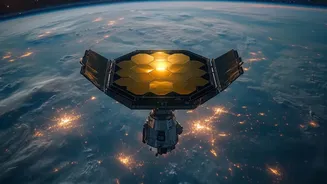
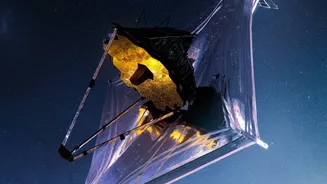
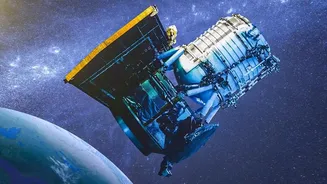
This is where the James Webb Space Telescope's specific design becomes so powerful. JWST is optimized to see the universe in infrared light, which is invisible to the human eye but holds a treasure trove of chemical information. Many of the molecules scientists are most interested in—especially those relevant to habitability like water (H2O), carbon dioxide (CO2), and methane (CH4)—have very strong and distinct absorption fingerprints in the infrared part of the spectrum. Previous telescopes, like Hubble, were more limited in their infrared capabilities. By focusing on this range, JWST can detect these key chemical signatures with unprecedented clarity and sensitivity, picking up signs of molecules that were previously hidden from view.
From Missing Light to a Chemical Map
To read the message hidden in the starlight, JWST uses instruments called spectrographs, such as NIRSpec and NIRISS. These tools spread the incoming light out into its full spectrum, like a prism creating a rainbow. But in this 'rainbow' from the starlight, there are dark lines or bands where light is missing. These are the absorption lines created by the exoplanet's atmosphere. By identifying the exact position and size of these dark lines, scientists can determine precisely which molecules are present. A significant dip at the wavelength corresponding to water means there's water vapor. A dark band at methane's signature wavelength means methane is present. By analyzing the entire pattern, astronomers can build a chemical inventory of the exoplanet's atmosphere, essentially 'mapping' its chemical makeup and even inferring its temperature and cloudiness.