


The Cosmic Shadow Play
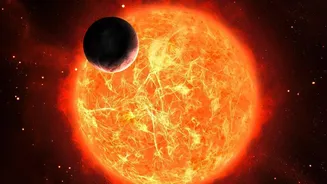
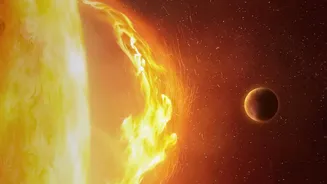
The entire process starts with a simple, yet elegant, cosmic alignment known as a 'transit'. This occurs when a distant planet, from our perspective, passes directly in front of its host star. As it does, it blocks a tiny fraction of the starlight, causing
a minuscule and temporary dip in the star's brightness. This transit method is how thousands of exoplanets have been discovered in the first place. But for atmospheric analysis, this shadow play is just the beginning. The real magic happens in the sliver of starlight that grazes the edge of the planet, passing through its atmosphere before continuing its journey across the cosmos to reach our telescopes.
Starlight as a Barcode Scanner
Think of the star's light as a pure, complete rainbow of colors, or a perfect barcode containing all wavelengths. When this light filters through an exoplanet's atmosphere, the gases present in that atmosphere absorb very specific colors, or wavelengths, of that light. Each gas—like water vapor, methane, or carbon dioxide—has a unique 'fingerprint' of light it absorbs. When the starlight emerges from the other side and reaches a telescope like the JWST, it's missing the specific slivers of light that the atmospheric gases soaked up. This creates a new, altered barcode with distinct gaps or dark lines in the spectrum.
Decoding the Barcode with Spectroscopy
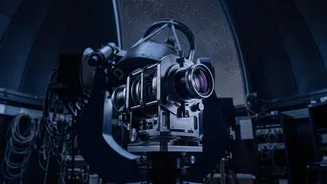
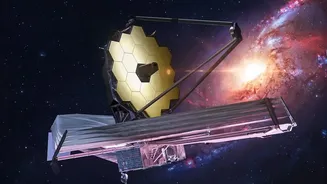
This is where the advanced technology of telescopes like the JWST truly shines. Instruments called spectrographs take this altered starlight and spread it out into its full spectrum, just like a prism creates a rainbow. By analyzing this spectrum and seeing exactly which 'bars' are missing from the original starlight barcode, scientists can identify precisely which gases are present in the planet's atmosphere. This technique is called transmission spectroscopy. The JWST is particularly powerful because it observes in infrared light, which is ideal for detecting many of the molecules that are key indicators for habitability and life.
The Hunt for Life's Ingredients
Scientists aren't just looking for any gases; they're hunting for 'biosignatures'—gases that, on Earth, are primarily produced by living organisms. The presence of gases like oxygen, methane, and carbon dioxide in a specific balance can be a tantalizing hint of biological processes. For instance, finding both methane and carbon dioxide together in a state of disequilibrium could suggest a living world, as biological activity might be required to continuously produce methane. Recent observations have even detected molecules like dimethyl sulfide on some exoplanets, a gas that on Earth is overwhelmingly produced by marine life. While these aren't definitive proof of life, they are compelling clues that guide further investigation.
From Data to a Distant Weather Map
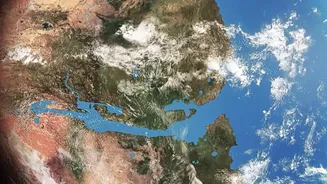
While we can't get a literal 'map' showing continents and oceans, this atmospheric data allows scientists to build sophisticated models of these distant worlds. By observing a planet at different points in its orbit, astronomers can even create temperature maps that show differences between the planet's day and night sides. The presence and thickness of clouds, the overall temperature, and the chemical composition all come together to paint a detailed portrait. It’s a process of assembling a complex puzzle from faint light signals that have travelled hundreds of light-years. This technique helps scientists distinguish between a barren rock and a potentially habitable, water-rich world.
The Challenges and a New Era of Exploration
This work is incredibly challenging. The signals are faint, and scientists must carefully rule out non-biological sources for the gases they detect. Distinguishing a potential biosignature from a purely geological process is a critical step that requires extensive modeling and observation. Furthermore, a telescope's time is precious, and getting enough data to confirm the presence of these gases can require observing dozens of transits. However, we are undeniably in a new era of exoplanet exploration. The ability to scan alien skies for their chemical makeup was once science fiction. Today, it's a fundamental tool in the search for answers to one of humanity's oldest and most profound questions.