




The Old Cosmic Story
Until now, the prevailing theory of galaxy formation was a 'bottom-up' model. The idea was that in the chaotic aftermath of the Big Bang, small, irregular clumps of gas and stars smashed into each other. Over billions of years, these violent mergers would
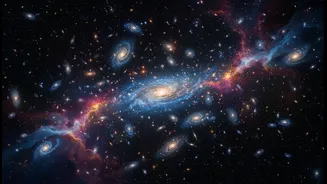
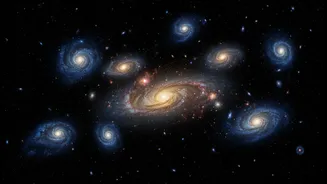
slowly build larger and larger galaxies. These repeated collisions would eventually settle down, allowing for the creation of the grand, structured galaxies we see in the nearby universe, like our own spiral-shaped Milky Way. Scientists believed that complex features like rotating discs and stellar bars—long structures that funnel gas to a galaxy's center—were late additions to the cosmic party, taking a vast amount of time to form and stabilize. The early universe was supposed to be filled with messy, clumpy, and disorganized galaxies, a cosmic construction site in its earliest phase.
A Glimpse Into the Past
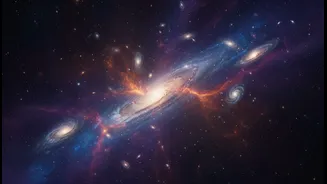
Enter the James Webb Space Telescope (JWST). With its incredible sensitivity, it can peer deeper into space, and further back in time, than any instrument before it. Recent observations, including those by a team from Durham University, have turned our cosmic story on its head. They examined a galaxy as it existed more than nine billion years ago, a mere 4.5 billion years after the Big Bang. What they found was shocking: a well-defined, star-forming structure known as a 'nuclear disc' at the galaxy's heart. This dense, rotating disc of stars was not only present but was being actively fed by a stellar bar—a feature previously thought to be a hallmark of much more mature galaxies. Finding such a sophisticated structure so early is a landmark discovery, providing direct proof that the building blocks of modern galaxies were in place far sooner than predicted.
Rewriting the Cosmic Rulebook
This discovery presents a major puzzle for astronomers. The traditional models simply don't allow enough time for such orderly structures to form. The universe was thought to need billions of years of gradual settling and merging before galaxies could develop these stable, complex features. The presence of a nuclear disc and a stellar bar in a galaxy from this early epoch suggests that the process of galaxy maturation is much faster and more efficient than we realized. It’s like finding a fully-built skyscraper in a city that was supposedly founded just a few years prior. This finding forces scientists to revisit fundamental assumptions about galaxy evolution. The early universe may not have been the purely chaotic mosh pit of galaxies we imagined, but a place where order and structure could emerge with surprising speed.
What This Means for Cosmic History
The implications of these findings are profound. If galaxies can build complex internal structures this quickly, it challenges our understanding of everything from star formation to the growth of supermassive black holes. Nuclear discs are believed to act as reservoirs of gas that fuel the giant black holes at the centers of galaxies. The early appearance of these discs could help explain how these black holes grew so massive, so quickly during the universe's most active period. This discovery is not an isolated incident; it's part of a growing pattern of JWST observations revealing that early galaxies were often larger, brighter, and more evolved than theories allowed. Astronomers are now tasked with figuring out what our models are missing. Is there a mechanism for rapid galaxy growth we don't know about? Do our theories about dark matter need adjusting? The hunt for answers has just begun, opening a thrilling new chapter in our quest to understand the universe.