




A Quantum Leap in a Tiny Box
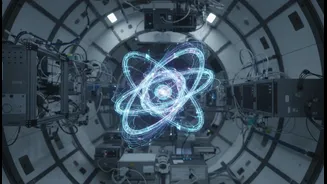
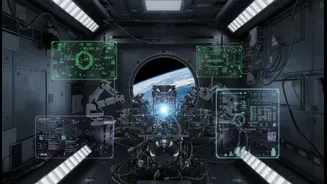
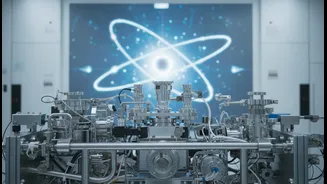
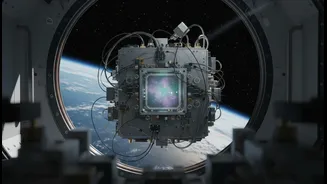
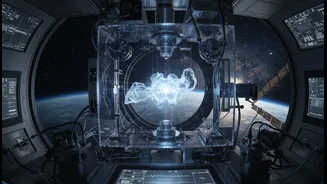
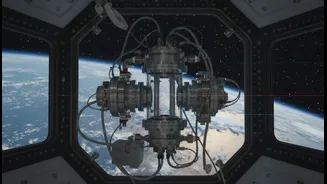
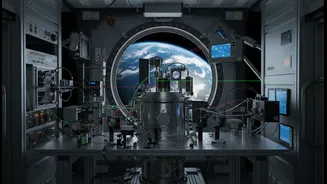
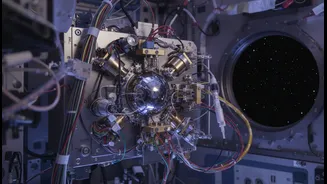
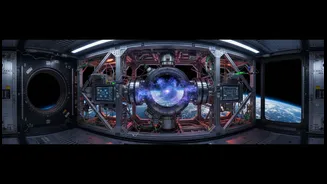
The Cold Atom Lab, or CAL, is a remarkable physics facility that has been operating on the International Space Station (ISS) since its installation in 2018. Managed remotely by scientists at NASA's Jet Propulsion Laboratory, its mission is to create temperatures
just a fraction of a degree above absolute zero—the theoretical point where all atomic motion ceases. By using a sophisticated process of lasers and magnetic fields, CAL chills clouds of atoms like rubidium and potassium to be colder than any naturally occurring place in the cosmos. Recent upgrades in 2026 have further enhanced its capabilities, allowing scientists to create larger and more complex quantum states than ever before.
Why Go Colder Than Deep Space?
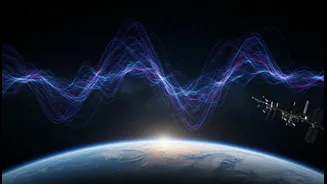
Cooling atoms to such extremes causes them to enter a bizarre fifth state of matter, first predicted by Satyendra Nath Bose and Albert Einstein. Known as a Bose-Einstein Condensate (BEC), this occurs when atoms get so cold and slow that their quantum nature takes over. Instead of behaving like individual particles, they merge into a single macroscopic quantum object—a 'super-atom' that acts like a single, coherent wave. This allows scientists to observe the strange rules of quantum mechanics, which are normally hidden at the microscopic level, on a much larger and more manageable scale.
The Microgravity Advantage
Creating a BEC on Earth is challenging. Gravity constantly pulls on the delicate atomic clouds, causing them to fall and limiting observation times to mere milliseconds. The microgravity environment of the ISS is the game-changer. Up there, a BEC can be held in place and observed for over a second, and in some cases for up to ten seconds or more. This extended observation time allows for much more precise measurements and enables experiments that are simply impossible to perform on the ground. It gives scientists a clean, force-free environment to study these fragile quantum systems without the disruptive influence of Earth's gravity.
The Promise of Precision Sensing
Beyond fundamental physics, CAL is a pathfinder for a new generation of ultra-precise quantum sensors. Because the atoms in a BEC are so sensitive to their surroundings, they can be used to detect tiny changes in forces like gravity. This technology, known as atom interferometry, uses the wave-like nature of cold atoms to make incredibly accurate measurements. Future quantum sensors based on this principle could revolutionize space exploration with GPS-free navigation systems, help map the gravitational fields of Earth and other planets to find water, or even probe cosmic mysteries like dark matter and dark energy.
Paving the Way for Quantum 2.0
The work being done on the Cold Atom Lab represents what some scientists call 'Quantum 2.0'. The first quantum revolution gave us technologies like lasers and transistors, which are based on the passive effects of quantum mechanics. This new phase is about actively controlling and manipulating large-scale quantum states. By demonstrating that this complex technology can work reliably in space, CAL is not only expanding our understanding of the universe but also laying the groundwork for a future where quantum technology is used for everything from enhanced medical imaging to next-generation computing and secure communications.