



A New Eye on the Universe
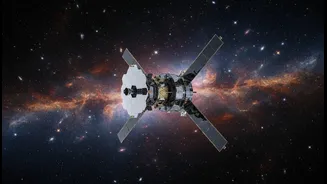
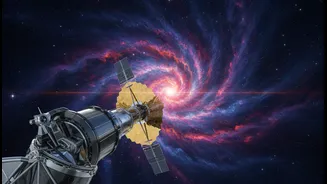
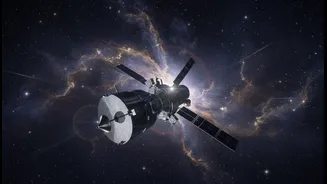
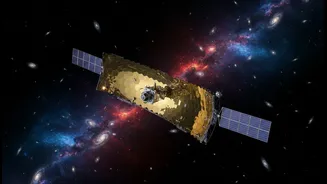
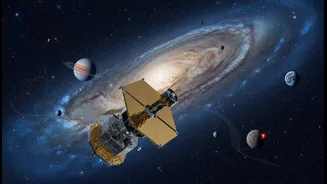
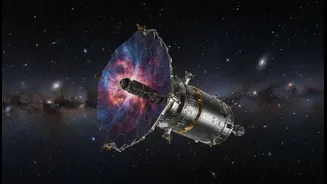
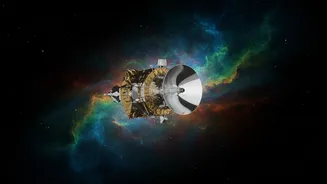
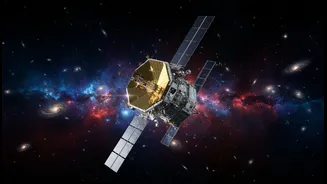
Set to launch on August 30, 2026, NASA’s Nancy Grace Roman Space Telescope is not just another observatory; it's a cosmic surveyor built for unprecedented speed and scale. Named after NASA's first chief of astronomy, who was instrumental in the development
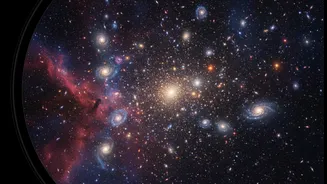
of the Hubble Space Telescope, Roman is designed to tackle some of the biggest questions in astrophysics. While Hubble gave us breathtakingly deep views of small patches of sky, Roman will provide panoramic vistas. It shares a primary mirror of the same size as Hubble's—2.4 meters—but its scientific purpose is fundamentally different. Rather than focusing on individual targets in extreme detail, Roman is built to rapidly scan enormous swathes of the universe, creating vast cosmic maps that will enable new kinds of discovery.
The Power of a Panoramic View
The secret to Roman's incredible speed is its Wide Field Instrument (WFI), a 300-megapixel infrared camera that gives it a field of view more than 100 times larger than Hubble's infrared camera. In a single snapshot, Roman can capture an area of the sky larger than the full moon. Where Hubble would need to painstakingly stitch together hundreds of images to map a galaxy like Andromeda, Roman could do it in just two pointings. This efficiency is why NASA estimates Roman can survey the sky up to 1,000 times faster than Hubble. It's not about seeing deeper in a single stare, but about seeing dramatically wider while maintaining Hubble-like image sharpness. This capability will allow it to image over 50 times more sky in its first five years than Hubble has in over 30 years, generating a torrent of data that would have previously taken centuries to collect.
Hunting for Cosmic Ghosts
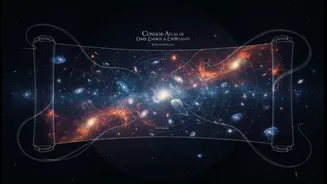
Two of the most profound mysteries in physics are dark energy and dark matter. Together, they are thought to make up about 95% of the universe, yet they remain invisible and poorly understood. Dark energy is the name given to the mysterious force causing the expansion of the universe to accelerate, while dark matter is the unseen mass whose gravity holds galaxies together. Roman will tackle these questions head-on. By mapping the precise locations of hundreds of millions of galaxies, it will trace the large-scale structure of the cosmos over time. This will help scientists measure the effects of dark energy with far greater precision. It will also map the distribution of dark matter by observing how its gravity bends the light from distant galaxies, a phenomenon known as weak gravitational lensing.
A Census of a Billion Worlds
Beyond cosmology, Roman is poised to revolutionize the search for exoplanets. It is projected to discover thousands of new worlds, potentially as many as 100,000 over its mission, which would dramatically increase the number of known planets. Roman will primarily use a technique called gravitational microlensing. This method works by monitoring the brightness of huge numbers of distant stars. If a closer star and its planets pass in front of a background star, their combined gravity can act like a lens, briefly magnifying the distant starlight. Because this technique is sensitive to planets of various sizes and at great distances from their star, it will help find worlds that other methods, like that used by the Kepler space telescope, often miss. This includes planets far from their stars, or even 'rogue' planets that float through space without a host star.
Testing Tomorrow's Technology
In addition to its main survey work, Roman is carrying a technology demonstration called the Coronagraph Instrument. This device is designed to block the overwhelming glare from a star, allowing astronomers to directly image faint planets orbiting it. While this is an experimental instrument, it will be a crucial test for technologies intended for future missions, like the planned Habitable Worlds Observatory, which aims to find and characterize Earth-like planets around other stars. The coronagraph will allow scientists to see Jupiter-like planets directly and even analyze the light from their atmospheres, providing a glimpse into the capabilities of the next generation of planet-finders.