


First, Let’s Define ‘Day’ and ‘Year’
Before we dive into Venus’s weirdness, let’s get our terms straight using Earth as a reference. A year is simple: it’s the time it takes for a planet to complete one full orbit around the Sun. For Earth, that’s about 365 days. A ‘day’, however, is trickier.
We usually think of a day as one cycle of sunrise to sunset, which scientists call a ‘solar day’. On Earth, this is 24 hours. But there's another kind of day: a ‘sidereal day’, which is the time it takes for the planet to rotate exactly 360 degrees on its axis. For Earth, a sidereal day is about 23 hours and 56 minutes, slightly shorter than our 24-hour solar day. This small difference is what makes the stars appear to rise about four minutes earlier each night.
Venus’s Bizarre Timekeeping
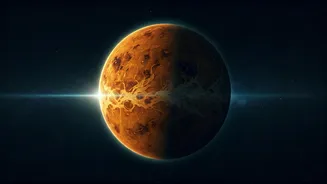
Now, let’s apply these concepts to Venus. A year on Venus—its journey around the Sun—is quite fast. It takes just about 225 Earth days to complete one orbit. So, a Venusian year is roughly two-thirds of an Earth year. Here’s where it gets mind-bending. Venus rotates on its axis incredibly slowly. In fact, it rotates backwards (a retrograde rotation) compared to Earth and most other planets in our solar system. One full, 360-degree rotation—a sidereal day—takes a staggering 243 Earth days. This means a single spin of the planet takes longer than its entire journey around the Sun. The headline is true: a single Venusian (sidereal) day is longer than a Venusian year. Because of its slow, backward spin, a solar day on Venus (sunrise to sunrise) is also very strange. It works out to about 117 Earth days. So, if you were standing on Venus, you would experience about 58 days of continuous daylight followed by 58 days of darkness. You'd only see two sunrises in a single Venusian year.
Why is Venus So Slow and Backwards?
Scientists don't have a single, definitive answer, but there are several leading theories. The most dramatic one suggests that early in its history, Venus may have been struck by a massive asteroid or another protoplanet. Such a cataclysmic impact could have been powerful enough to not just halt its original spin but reverse it entirely. Another compelling theory involves Venus's crushingly thick atmosphere and the Sun's gravity. The Venusian atmosphere is about 90 times denser than Earth's and creates immense friction and pressure on the surface. Over billions of years, powerful atmospheric tides, created by the Sun's heat, could have acted as a brake on the planet's rotation. This, combined with gravitational tides from the Sun pulling on the solid body of Venus, could have gradually slowed it down and even flipped its spin axis.
A World of Extremes
This slow rotation has profound consequences. It contributes to Venus being the hottest planet in our solar system, even though Mercury is closer to the Sun. The incredibly thick atmosphere, composed mainly of carbon dioxide, has created a runaway greenhouse effect. Temperatures on the surface are hot enough to melt lead, averaging around 465°C. The slow spin also means Venus lacks a strong magnetic field like Earth's. Our planet's rapid rotation helps generate a magnetic field that protects us from harmful solar radiation. Without this protective bubble, Venus's upper atmosphere is constantly stripped away by the solar wind. These extreme conditions make it one of the most inhospitable places imaginable, a 'hellscape' twin to our own world.