




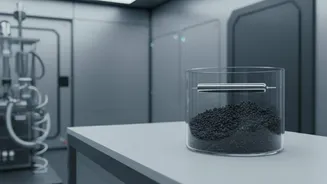
The Challenge: Space Travel's Luggage Problem
Every mission beyond Earth faces a fundamental constraint: everything must be brought along. For long-term human settlements on the Moon, the cost and complexity of launching life-sustaining resources like oxygen from Earth is a monumental barrier. A
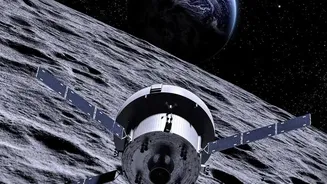
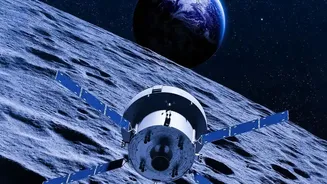
sustainable human presence requires living off the land, a concept known as In-Situ Resource Utilization (ISRU). NASA's Artemis program, which aims to establish a permanent base at the Moon's south pole, is heavily invested in making ISRU a reality. This means finding ways to use lunar resources to produce breathable air, water, and even rocket fuel. Until now, this has been a theoretical solution, but recent breakthroughs are changing the game.
Making Air From Moon Dust
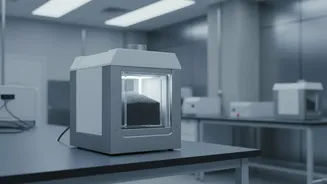
The Moon may be airless, but its soil, or regolith, is rich in oxygen—making up about 45% of its mass. The oxygen isn't free-floating; it's chemically bound within silicate minerals. The challenge is breaking those strong chemical bonds. NASA, in partnership with companies like Sierra Space, has been advancing a process called carbothermal reduction to do just that. The project, known as the Carbothermal Reduction Demonstration (CaRD), recently passed a major milestone by successfully extracting oxygen from simulated lunar soil in a vacuum environment, proving the concept can work on the Moon.
How the Lunar Oxygen Factory Works
The carbothermal reduction process is an ingenious way to bake oxygen out of rocks. It works by heating lunar regolith to very high temperatures—around 1,700°C—using concentrated solar energy. This intense heat, focused by a solar concentrator, melts the soil. A carbon source is used to react with the metallic oxides in the molten regolith, which releases carbon monoxide (CO). This CO gas is then captured. In a full-scale system, subsequent steps would split the carbon monoxide, yielding pure, breathable oxygen and recycling the carbon for the next batch. Recent tests have confirmed that concentrated sunlight alone is enough to drive this crucial reaction, a significant step toward a self-sufficient system on the Moon.
Why This Is a Game-Changer
The ability to produce oxygen on the Moon fundamentally changes the economics and logistics of space exploration. It's not just for breathing; oxygen is also a key component of rocket propellant. Being able to manufacture propellant on the Moon would transform it into a refuelling station for deeper space missions, including eventual journeys to Mars. A system capable of producing several times its own weight in oxygen per year could drastically reduce the number of costly resupply missions from Earth. This frees up mass on future launches for other critical hardware, like habitats, scientific instruments, and rovers, accelerating the development of a true lunar outpost.
From Lab Prototype to Lunar Reality
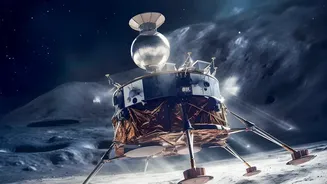
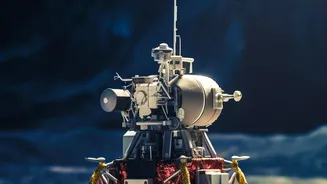
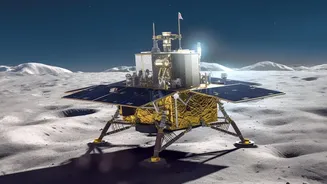
While the technology has been proven in vacuum chambers on Earth, the next step is to test it on the Moon itself. The CaRD project team has successfully demonstrated the prototype, integrating the reactor, solar concentrator, and control systems. The technology is being matured to what NASA calls "technology readiness level six," making it a candidate for a future Commercial Lunar Payload Services (CLPS) mission. This means a version of this oxygen factory could soon be sent to the lunar surface to prove it can withstand the harsh environment—from abrasive, clinging dust to extreme temperature swings—and operate autonomously. Successfully operating this system on the Moon will be the final proof needed before scaling it up to support the first long-term human crews under the Artemis program.