

The Sun's Hidden Danger
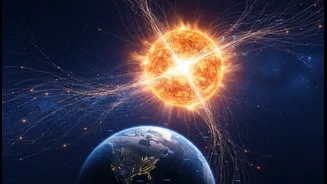
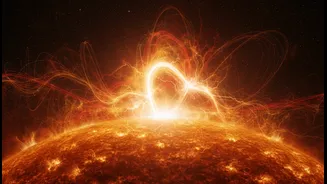
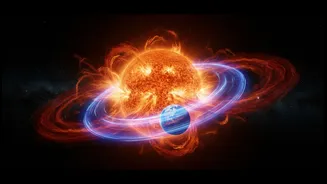
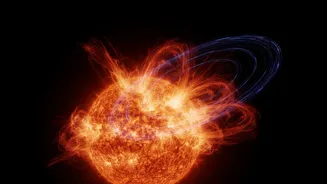
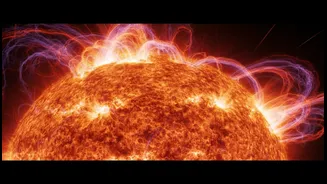
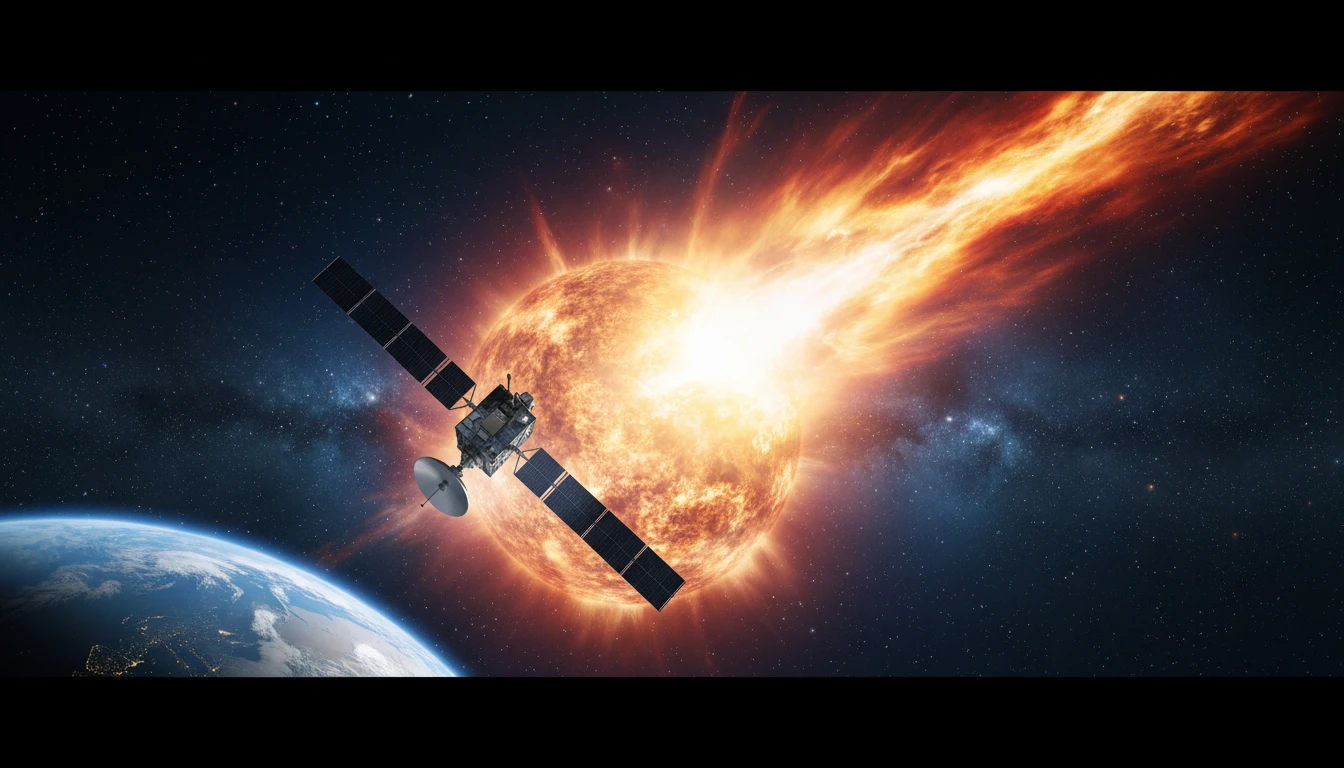
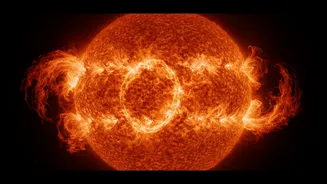
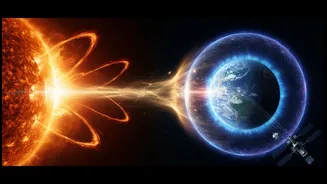
The Sun, our life-giving star, has a volatile side. It periodically ejects massive clouds of charged particles and magnetic fields, an event known as a Coronal Mass Ejection (CME). When these CMEs are aimed at Earth, they can trigger geomagnetic storms.
While they produce beautiful auroras, these storms pose a significant threat to our high-tech civilisation. They can disrupt and damage satellites, interfere with GPS and communication signals, and even induce powerful currents in power grids, potentially causing widespread blackouts. The 1859 Carrington Event, the most powerful storm on record, crippled telegraph systems worldwide; a similar event today could have catastrophic economic and societal consequences.
A Race Against Time
Forecasting space weather is incredibly challenging. Unlike Earth weather, which we can see and feel developing, solar storms offer little warning. Particles from a solar flare can reach Earth in minutes, while the bulk of a CME arrives in one to three days. For decades, forecasters have relied on monitoring sunspots—dark, magnetically active regions on the Sun's surface—and data from a handful of aging satellites. While these methods are useful, they often provide only a short lead time and limited detail, making it a constant race to issue warnings and protect vulnerable infrastructure like India's growing satellite networks and digital payment systems.
The AI-Powered Forecaster
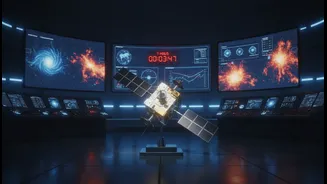
This is where the new generation of forecasting tools comes in. Scientists are now harnessing the power of artificial intelligence and machine learning to sift through vast amounts of solar data far faster than any human could. Models like SEPNET-O are being tested to provide warnings of dangerous solar radiation up to 24 hours in advance, a crucial development for protecting astronauts. Other new models, like the open-source 'Aether', are moving beyond simple predictions to generate probabilistic forecasts, much like modern terrestrial weather reports. These AI models are trained on decades of satellite imagery and magnetic data, learning to identify the subtle signatures that precede a major solar eruption, promising a new era of faster, more accurate warnings.
India’s Eye on the Sun
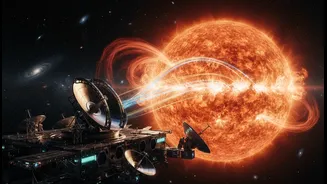
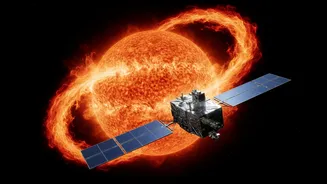
A crucial part of this global effort is a fleet of advanced solar observatories, both on the ground and in space. Telescopes like the Daniel K. Inouye Solar Telescope provide unprecedentedly detailed views of the Sun's magnetic fields, which are the root cause of space weather. For India, the Aditya-L1 mission is a game-changer. Positioned at the L1 Lagrange point, a stable spot between the Sun and Earth, it has an uninterrupted view of the Sun. Its suite of instruments provides vital data on solar eruptions and the solar wind. Data from Aditya-L1 is not just about protecting Indian assets; it's a critical contribution to the global scientific community, helping to refine and validate these new AI-driven forecasting models. A recent study using Aditya-L1 data helped decode the impact of a powerful storm, highlighting the mission's importance in real-time assessment.
Protecting Our Digital Future
The combination of new observatories and intelligent forecasting tools represents a major leap forward in our planetary defence against space weather. Better forecasts give power grid operators time to re-route power and protect transformers. Airlines can divert flights away from polar regions where radiation exposure is highest during a storm. Satellite operators can put their spacecraft into a safe mode to ride out the worst of the radiation. For a nation like India, with ambitious space programs and a rapidly digitising economy, this improved resilience is not a luxury—it's a necessity. These tools help safeguard everything from our NavIC navigation system to the digital infrastructure that powers the economy.