


A New Era of Planet Hunting
For decades, finding planets outside our solar system—known as exoplanets—was a game of shadows. Astronomers would detect the faint dip in a star's light as a planet passed in front of it. This told us a planet was there, and its size, but very little
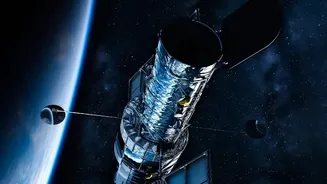
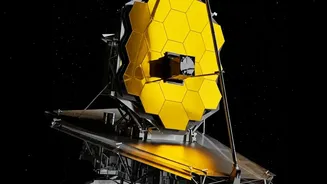
else. It was like knowing a house exists but never being able to look through the windows. The James Webb Space Telescope changes all of that. Launched with the most advanced set of infrared instruments ever sent to space, it's not just finding planets; it's getting to know them on a chemical level.
The Magic of Infrared Light
The secret to Webb’s power is its ability to see the universe in infrared light. When a planet passes in front of its star, a tiny fraction of the starlight filters through the planet's atmosphere. Different chemical elements and molecules in that atmosphere absorb specific wavelengths, or colours, of this light. By capturing a spectrum—a sort of chemical barcode—Webb’s instruments, like the Near-Infrared Spectrograph (NIRSpec), can identify which molecules are present. This technique, called transmission spectroscopy, allows scientists to detect the building blocks of an atmosphere, such as water, methane, and carbon dioxide, from across the galaxy.
Peering into a Water World
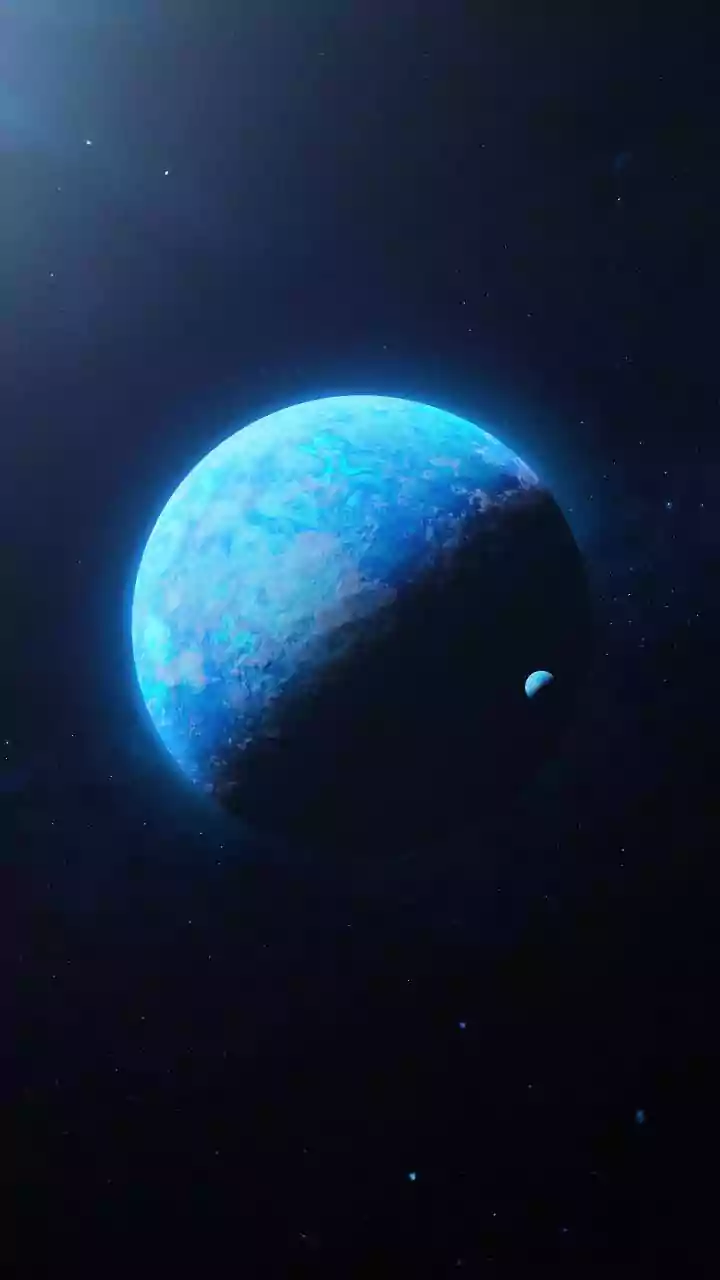
One of the most tantalizing targets for JWST has been K2-18 b, a planet 120 light-years away that is more than eight times the mass of Earth. What makes it special is that it orbits within its star's habitable zone, the region where temperatures could allow for liquid water. Webb's observations have confirmed the presence of carbon-bearing molecules like methane and carbon dioxide in its atmosphere. These findings support the theory that K2-18 b could be a 'Hycean' world—a hot, ocean-covered planet with a hydrogen-rich atmosphere, a type of planet unlike anything in our solar system.
The Hunt for Signs of Life
The discoveries on K2-18 b get even more exciting. Some studies have suggested the tentative presence of a molecule called dimethyl sulfide (DMS). On Earth, DMS is overwhelmingly produced by life, particularly marine phytoplankton. This is by no means a confirmation of alien life; the signal is weak and requires much more observation to be verified, and there could be unknown geological or chemical processes that produce the gas. However, it represents one of the most significant leads yet in the search for biosignatures—chemical hints of biological activity—outside our solar system. It showcases Webb's power to move the search for life from science fiction into the realm of testable science.
Beyond Atmospheres: Seeing the Unseen
While spectroscopy is its primary tool, JWST is also capable of directly imaging exoplanets, a feat that is incredibly difficult due to the overwhelming glare of their host stars. In 2026, astronomers used Webb to discover a new planet, Beta Pictoris d, not by seeing it directly as a point of light, but by detecting the chemical signature of its atmosphere hiding within its star's dusty debris disk. Its atmosphere contained carbon monoxide, water vapor, and methane. This novel technique promises to reveal planets that were previously impossible to find, opening yet another new frontier in exoplanet exploration.