






The Coolest Lab in the Universe
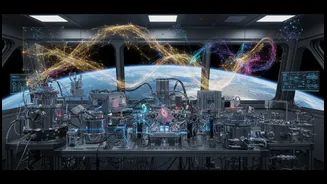
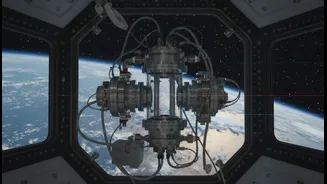
Aboard the International Space Station (ISS) orbits a mini-fridge-sized facility with a claim to fame: it is one of the coldest places in the known universe. This is NASA’s Cold Atom Lab, and it’s the frontier of quantum research in space. Inside, scientists
can cool atoms to just a fraction of a degree above absolute zero, the theoretical point where all atomic motion ceases. At these extreme temperatures, clouds of atoms stop behaving like individual particles and transform into a bizarre fifth state of matter, a Bose-Einstein condensate, where they act like a single, massive quantum wave. First installed in 2018, the lab has become a vital tool for studying physics in ways impossible on Earth.
A Major Quantum Upgrade
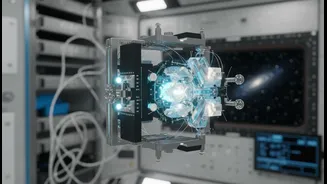
The latest headline-making expansion refers to a significant hardware upgrade recently installed on the Cold Atom Lab by astronauts. This is the fourth major enhancement since the lab began operations, involving a newly designed magnetic trap and improved atom sources. These upgrades allow scientists to not only create these ultracold atom clouds more effectively but also to manipulate their shape, squeezing them into different forms to study new quantum properties. By leveraging the microgravity of space, where these delicate quantum states can be observed for much longer periods than on Earth, researchers are pushing the boundaries of what they can control at the quantum level.
The 'Quantum 2.0' Revolution
Scientists at NASA's Jet Propulsion Laboratory refer to this work as 'Quantum 2.0'. The first quantum revolution gave us transformative technologies like lasers, transistors for our smartphones, and MRI machines. This next phase is about the direct manipulation of large quantum states. The goal is to mature quantum technology so it can operate reliably in space, paving the way for a new generation of powerful tools. The work done on the Cold Atom Lab is a crucial demonstration, proving that complex quantum experiments can be operated remotely and successfully in orbit.
New Tools for Exploring the Cosmos
The practical applications of this research are profound. One of the most promising developments is in quantum sensors. These devices use the wave-like properties of atoms to measure forces like gravity with unprecedented precision. This technology, known as atom interferometry, could enable future spacecraft to navigate deep space, including on the Moon, without relying on GPS. It could also be used to create incredibly detailed maps of the gravity fields of Earth or other planets, revealing secrets hidden underground, such as water aquifers or mineral deposits. These sensors could also become invaluable tools in the search for mysterious cosmic phenomena like dark matter and dark energy.
From the Space Station to Earth and Beyond
While the Cold Atom Lab is focused on fundamental physics, the technologies it's pioneering have direct benefits for us on Earth. The ability to precisely measure Earth's gravitational field from space can lead to better monitoring of climate change effects, like melting ice sheets and changing sea levels. More accurate gravity maps are also essential for resource management and national security. Looking further ahead, NASA is already planning future missions, like the Quantum Gravity Gradiometer Pathfinder, which will be the first space-based instrument to observe Earth’s gravity field with an atom interferometer. This is a critical step toward building a new generation of instruments for exploring our planet and the universe.