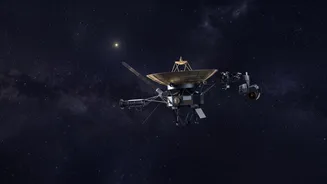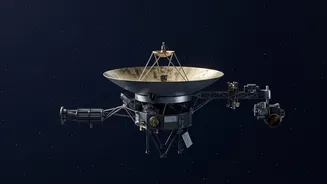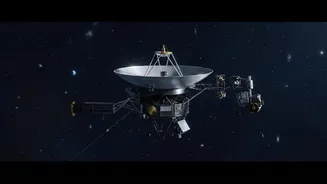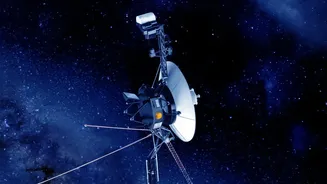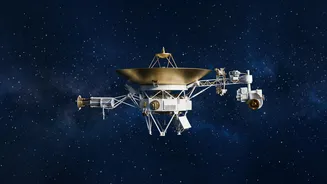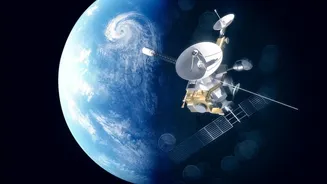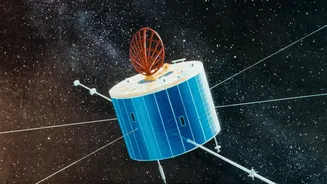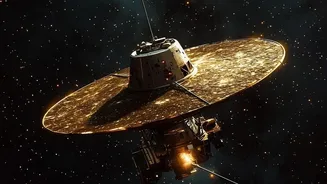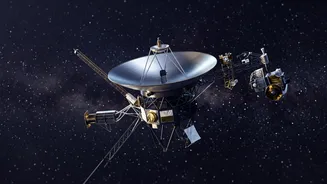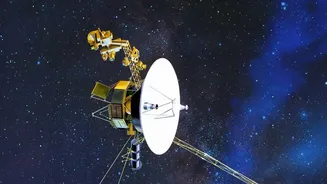






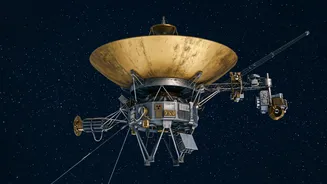
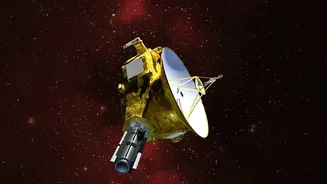
On November 18, 2026, a machine launched nearly 50 years ago will achieve something unprecedented. NASA’s Voyager 1 will become the first human-made object to be one light-day from Earth, a testament to enduring curiosity and engineering.
A Milestone Measured in Light
So, what exactly
is a light-day? It isn’t a measure of time, but of immense distance. It’s how far a particle of light travels in a full 24 hours. That equates to roughly 25.9 billion kilometres. To put that into perspective, light from our Sun takes just over eight minutes to reach Earth. Voyager 1's milestone means that on November 18, the radio signals it sends back to us will take an entire day to arrive. Consequently, any command sent from NASA's mission controllers will also take a day to reach the probe, making a simple round-trip communication a 48-hour affair. This incredible distance highlights the sheer scale of Voyager's journey and the challenges of communicating across the cosmos.
A Grand Tour and an Unexpected Future
When Voyager 1 launched on September 5, 1977, its primary mission was a five-year 'Grand Tour' of the outer planets. Taking advantage of a rare planetary alignment that happens once every 175 years, it performed historic flybys of Jupiter in 1979 and Saturn in 1980. It sent back the first detailed images of their moons and rings, discovering active volcanoes on Jupiter's moon Io and the complex, hazy atmosphere of Saturn's moon Titan. After its encounter with Saturn, its path took it out of the plane of the solar system, beginning a new, unforeseen mission: a journey into the void between the stars.
Crossing into Interstellar Space
In August 2012, Voyager 1 made history by crossing the heliopause — the boundary where the Sun’s stream of charged particles meets the interstellar medium. It officially became the first human-made object to enter interstellar space, the vast expanse between star systems. While it has left the Sun's protective bubble, it hasn't technically left the solar system. It will take another 300 years just to reach the inner edge of the Oort Cloud, a theoretical shell of icy objects still gravitationally bound to the Sun, and another 30,000 years to pass through it. Still, its instruments continue to send back invaluable data about an environment humanity has never directly measured before.
Keeping a Fading Explorer Alive
Keeping a nearly 50 year old spacecraft operational at such an extreme distance is a monumental feat. Voyager $^$1's plutonium power source generates less energy each year, forcing engineers to make difficult decisions about which instruments to shut down to conserve power. The mission has also faced recent technical scares. In late $^$2023, the probe began sending back unreadable 'gibberish' due to a faulty memory chip, a problem that took engineers months to diagnose and fix. More recently, in October $^$2026, the spacecraft went silent for $^$48 hours before its automated fault protection systems activated backup thrusters and re established contact, a nerve wracking reminder of the probe's fragility.
Humanity's Message in a Bottle
Beyond its scientific mission, Voyager $^$1 serves as a cultural ambassador. Attached to its side is the Golden Record, a $^$12 inch,$^$ gold plated copper disk intended as a message for any intelligent life that might one day encounter it. The record contains $^$116 images,$^$ a variety of natural sounds,$^$ musical selections from different cultures and eras,$^$ and spoken greetings in $^$55 languages.$^$ It also carries the famous '$^$'Pale Blue Dot'$^$' image,$^$ a photograph of Earth taken in $^$1990 from $^$6 billion kilometres away.$^$ This record will long outlast the spacecraft’s operational life,$^$ a silent testament to the species that sent it on its way,$^$ wandering the Milky Way for potentially billions of years.