



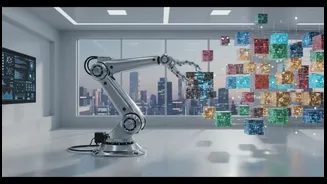



The New AI Colleague on the Block
First, what is Julius AI? It's part of a new generation of AI assistants designed to understand plain English and perform complex tasks. Specifically, Julius and similar platforms can analyse data, generate reports, and, crucially, write code in languages
like Python and SQL based on simple text commands. Instead of a developer manually writing hundreds of lines of code for a standard function, they can now ask the AI to generate it in seconds. This isn't about a single magical tool but a broader trend of AI becoming a collaborator in the software development process, automating repetitive and time-consuming tasks. These tools are no longer a futuristic concept; they are being integrated into workflows at major companies.
From Manual Coding to Strategic Prompting
The core of the shift lies in how work gets done. Previously, an entry-level coder's day was filled with writing 'boilerplate' code, fixing basic bugs, and running manual tests — well-defined, repetitive tasks. AI assistants excel at exactly this kind of work. A developer using an AI tool can see productivity boosts of up to 55%, completing tasks much faster. As a result, the demand is no longer for a 'manual coder' who can type syntax, but for a 'problem solver' who can effectively instruct the AI. The valuable skill is moving from writing the code yourself to being able to formulate a clear, precise request (a 'prompt') and then critically evaluating the AI's output for accuracy, security, and efficiency.
The Impact on India’s Fresher Hiring
This change is having a tangible impact on the Indian job market, which has historically relied on a pyramid model with a large base of entry-level hires. Recent data shows a structural decline in fresher hiring at major IT firms, even as the overall tech workforce grows. The share of entry-level roles has dropped significantly as companies find they can achieve the same output with smaller, AI-augmented teams. According to one report, AI is already handling a significant portion of entry-level tasks in India, a rate higher than the global average. This doesn't mean jobs are vanishing entirely, but the entry point is becoming more challenging and requires a different, higher-level skill set from day one.
The Rise of the 'AI-Augmented' Developer
The narrative isn't one of replacement, but of evolution. The most sought-after professionals are now those who can blend traditional domain knowledge with AI fluency. Companies are increasingly looking for skills that AI cannot replicate: critical thinking, system design, business acumen, and creativity. The focus is shifting from 'Can you code?' to 'Can you solve this business problem using code and AI tools?' Entry-level roles now demand an understanding of how to integrate AI, work with data, and ensure the security of AI-generated code. This creates a demand for 'AI-augmented' developers who can leverage technology as a partner rather than just using it as a tool.
How to Future-Proof Your Tech Career
For aspiring tech professionals in India, the path forward is not to fear AI, but to embrace it. The focus of education and self-study must shift. Foundational knowledge of coding and data structures remains important, but it is no longer enough. Aspiring developers should actively use tools like Julius AI, GitHub Copilot, and others to understand their capabilities and limitations. Building a portfolio that demonstrates not just coding projects, but projects where AI tools were used to achieve a complex outcome, is critical. Furthermore, developing 'human-centric' skills like communication, collaboration, and creative problem-solving is essential, as these are the areas where humans continue to hold a distinct advantage over machines.