


A Treasure Hidden in Perpetual Shadow
For decades, the Moon was thought to be bone dry. But a series of orbital missions revealed a different story, confirming the presence of water ice, particularly at the lunar poles. The south pole is especially promising because it contains permanently
shadowed regions (PSRs)—craters and depressions that have not seen direct sunlight in billions of years. Because of the Moon's axial tilt, the floors of these craters are some of the coldest places in our solar system, acting as perfect cold traps for water ice. This ancient ice is mixed with lunar soil, or regolith, and missions are being designed to map out exactly where the most concentrated deposits are located.
More Than Just a Drink of Water
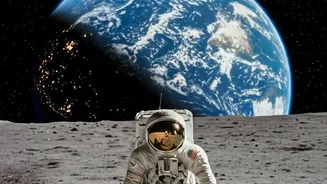
The most obvious use for water is life support. For astronauts living and working at a future lunar base, a local water source is a game-changer. It means they can have drinking water, grow food, and produce breathable oxygen without having to ship every last drop from Earth at an astronomical cost. Every gallon of water sourced from the Moon is a gallon that doesn't need to be launched, dramatically reducing the mass and expense of missions. This practice, known as in-situ resource utilization (ISRU), is the cornerstone of making long-term human habitation on the Moon sustainable.
A Fuelling Station for the Solar System
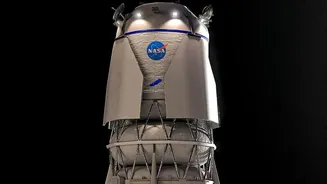
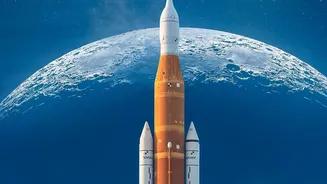
The true revolutionary potential of lunar ice goes far beyond life support. Water (H2O) can be separated into its elemental components, hydrogen and oxygen, through a process called electrolysis. These two elements are the primary components of modern rocket propellant. By extracting and processing lunar ice, NASA can essentially turn the Moon into a deep-space fuelling station. Spacecraft could launch from Earth with just enough fuel to get to the Moon, refuel there, and then continue on to more distant destinations like Mars. This single capability would break the 'tyranny of the rocket equation,' which dictates that the more you want to carry and the farther you want to go, the exponentially more fuel you need at liftoff.
The Tools for a New Gold Rush
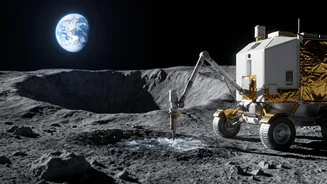
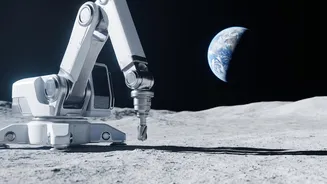
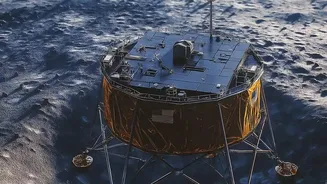
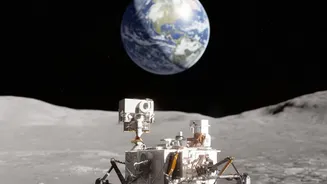
Finding and extracting this lunar 'gold' is a major technological challenge. The ice is not a neat, solid sheet but is mixed with abrasive lunar dust at cryogenic temperatures. NASA and its commercial partners are developing an array of technologies to tackle this. Robotic missions are key to prospecting the region. Instruments like the Neutron Spectrometer System will help map hydrogen concentrations from rovers, indicating where water is most abundant. Experimental drills and processing plants, like those tested in the PRIME-1 mission, are being designed to bore into the frozen regolith, heat it to release the water vapor, and then capture and purify it. These early robotic missions serve as critical pathfinders, scouting the best locations and testing the hardware needed before astronauts arrive to set up a larger-scale operation.