
What Are Space Storms?
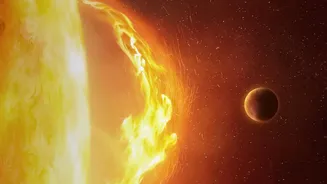
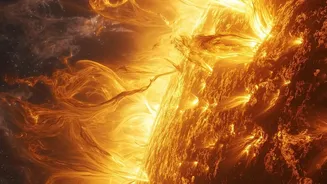
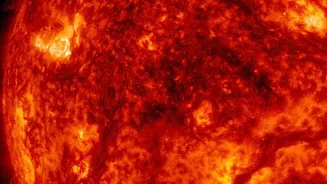
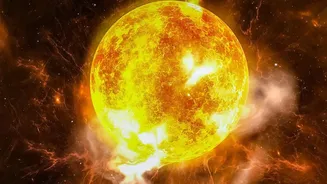
A space storm, or solar storm, is a major disturbance in near-Earth space caused by the Sun. These events occur when the Sun ejects massive bursts of energy, plasma, and magnetic fields, known as Coronal Mass Ejections (CMEs) or solar flares. While Earth's
magnetic field, the magnetosphere, protects us from most of this onslaught, a powerful storm can compress this shield. The consequences can be significant, disrupting everything from satellite communications and GPS navigation to power grids on the ground. As our reliance on this technology grows, so does our vulnerability to space weather.
A Unique Vantage Point
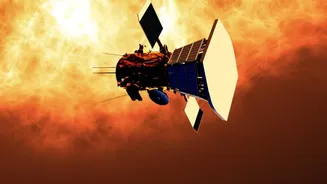
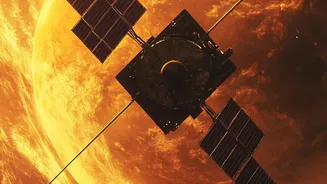
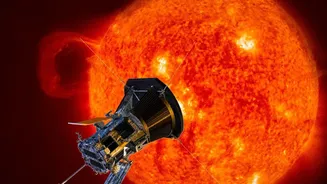
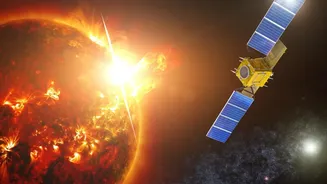
Aditya L1's effectiveness comes from its strategic location: the first Lagrange point (L1). This is a special spot in space where the gravitational pulls of the Sun and Earth balance each other out. Operating in a 'halo orbit' around this point, the spacecraft can maintain its position with minimal fuel and, most importantly, gets a constant, uninterrupted view of the Sun. Unlike satellites in Earth's orbit, it never experiences eclipses. This continuous monitoring is the key to early warnings, as solar storms and charged particles reach the L1 point about an hour before they reach Earth, giving scientists crucial lead time to issue alerts.
The Eyes on the Sun
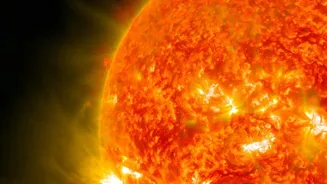
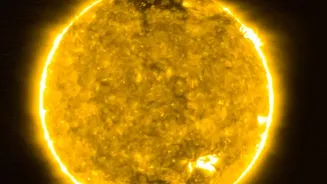
Aditya L1 carries seven sophisticated instruments, four for remote sensing of the sun and three for in-situ measurements of the local environment. Two of the most critical for storm prediction are the Visible Emission Line Coronagraph (VELC) and the Solar Ultraviolet Imaging Telescope (SUIT). VELC is designed to study the Sun's outer atmosphere, the corona, which is where CMEs originate. It can observe these massive eruptions right from their onset, gathering data on their speed, mass, and temperature. SUIT, on the other hand, captures full-disk images of the Sun in near-ultraviolet wavelengths, allowing scientists to observe the lower layers of the solar atmosphere and understand the processes that lead to these powerful events.
From Data to Forecast
The data from Aditya L1's instruments allows scientists to see a solar storm as it is born. When VELC spots a CME, it can measure the properties of the ejected plasma. Meanwhile, SUIT provides context by observing the activity on the Sun's surface and in its lower atmosphere that triggered the event. Other in-situ instruments on Aditya L1, like its magnetometer and particle analysers, directly measure the solar wind and magnetic fields as they pass the spacecraft. By combining all this information—the initial eruption imagery from VELC, the atmospheric context from SUIT, and the direct measurements of the solar wind—scientists can model the CME's trajectory and intensity. This allows them to predict if the storm is heading towards Earth and how severe its impact might be, a significant step forward for India's space weather prediction capabilities.
A New Era for Indian Space Science
With Aditya L1, India joins a select group of nations capable of monitoring space weather from a dedicated observatory. The mission is already providing breakthrough data, helping scientists understand the fundamental physics of the Sun, such as the long-standing mystery of why its corona is millions of degrees hotter than its surface. These insights not only advance pure science but also have practical applications. By improving our understanding of the mechanisms that drive solar flares and CMEs, the data helps refine prediction models. This homegrown capability is crucial for protecting India's growing fleet of satellites and terrestrial infrastructure, solidifying its position as a major, self-reliant space-faring nation.