


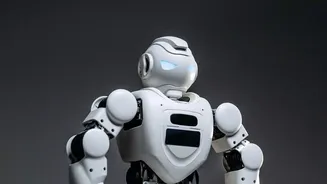
The idea of humanoid robots working alongside people is no longer science fiction. Major companies are now testing them on factory floors. But before they become commonplace, these machines face a crucial test of everyday, real-world practicality.
From the Lab to the Assembly Line
The
era of humanoid robots as purely experimental lab projects is over. In recent years, they have entered real manufacturing environments, marking a significant step toward commercial viability. Automakers have been leading the charge. BMW, for instance, has been piloting robots from Figure AI at its Spartanburg, South Carolina plant. The initial deployment saw the Figure 02 robot handling sheet metal parts, a physically demanding and repetitive task, contributing to the production of over 30,000 vehicles. Following this, the next-generation Figure 03 was introduced to tackle more complex logistics and sequencing tasks. Similarly, Mercedes-Benz has partnered with Apptronik to deploy its Apollo robot, a descendant of NASA's Valkyrie, in its facilities. The goal is to automate physically challenging manual labour, such as delivering parts and assembly kits to the production line. Even technology companies are getting involved, with Xiaomi recently showcasing its robot working an eight-hour shift in its own EV factory.
The Hurdles of the Real World
Despite these impressive pilot programs, the path to widespread adoption is filled with practical obstacles. A key challenge is reliability and endurance. Industrial customers expect equipment to run with 95-99% uptime, a standard most current humanoids struggle to meet. A major limiting factor is battery life; many robots can only operate for two to four hours before needing a recharge, far short of a full human work shift. This makes continuous, 24/7 operation difficult without significant downtime or complex battery-swapping systems. Another hurdle is the robot's ability to adapt. Factory floors are dynamic and less predictable than a controlled lab. A robot must be able to handle parts that are not perfectly positioned or deal with unexpected obstacles, which requires sophisticated AI that is still being perfected. While AI has made huge leaps, handling these 'edge cases' reliably remains a significant challenge.
The Economic Calculation
For any business, the decision to adopt new technology comes down to the return on investment. Humanoid robots carry a high upfront cost, with current units priced anywhere from $50,000 to over $200,000. This is a substantial investment, especially when compared to existing, purpose-built automation like robotic arms, which are often faster and more reliable for a single, specific task. Proponents argue that costs are falling rapidly, with some projections suggesting prices could drop to around $37,000 by 2030. At that price, the economics become far more compelling, especially when factoring in a robot's ability to potentially work multiple shifts without benefits or breaks. However, for now, companies must weigh the high initial outlay and maintenance costs against the potential savings from automating physically demanding or undesirable jobs and addressing labour shortages. The business case is not yet a slam dunk for most applications.
Safety and Human Collaboration
Perhaps the most critical test is ensuring these powerful machines can work safely and seamlessly alongside human employees. Unlike traditional industrial robots that are often caged off for safety, humanoids are designed to operate in humancentric spaces. This requires a new level of safety engineering, including advanced sensors and software to prevent collisions and ensure predictable behaviour. The robots must be able to navigate crowded floors and react gracefully to the unpredictable movements of people. Beyond physical safety, there's the element of trust and integration. For these robots to be effective, their human colleagues need to be comfortable working with them. This involves not only proving their reliability but also designing their interactions to be intuitive and nonthreatening. Companies like Apptronik have focused on a 'friendly' design for their Apollo robot to facilitate this humanrobot collaboration. The success of these deployments will depend as much on social acceptance on the factory floor as it will on technical performance.