



Reading Atmospheres from Afar
One of the most powerful techniques for studying distant planets is called transit spectroscopy. When an exoplanet passes in front of its host star from our point of view, a tiny amount of starlight filters through the planet's atmosphere. Scientists
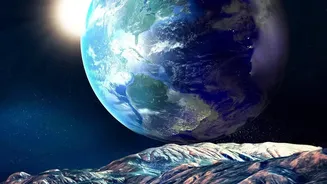
can analyze this light to see which wavelengths have been absorbed by gases in that atmosphere. Every gas has a unique spectral "fingerprint," and by comparing the light that passed through the atmosphere to the light that didn't, astronomers can identify key molecules like water vapor, methane, and carbon dioxide. Our own planet's atmospheric composition serves as the primary reference library for these fingerprints, allowing scientists to decode the chemical makeup of worlds trillions of miles away.
Earth as a Time Machine
Our planet wasn't always the blue and green world we see today. Earth's 4.5-billion-year history includes phases where the atmosphere was radically different, from a carbon dioxide-heavy cloak to an oxygen-free environment. Scientists model these past geological eras to create templates for what other planets might look like at different stages of their own evolution. For example, studying the Archean Eon, when Earth may have been shrouded in an orange organic haze, helps astronomers understand potentially habitable but hazy exoplanets. By looking into our own planet's deep past, we get a preview of alien worlds that might be young, developing, or simply different from modern Earth.
The Search for Biosignatures
The ultimate goal for many astronomers is to find signs of life, known as biosignatures. These are gases or combinations of gases that are unlikely to exist without a biological source. On Earth, the simultaneous presence of oxygen and methane is a strong indicator of life. Oxygen is highly reactive and would quickly disappear without being constantly replenished by photosynthesis, while methane is often produced by living organisms. Finding this specific pair of gases in an exoplanet's atmosphere would be a monumental discovery. Scientists study the delicate chemical balance of Earth's biosphere to know which combinations of gases scream "life" versus those that can be explained by geology or chemistry alone.
Life at the Extremes
When we think of habitable conditions, we tend to imagine environments like our own. But life on Earth exists in places that seem utterly alien. These organisms, called extremophiles, thrive in boiling hot springs, highly acidic waters, salty lakes, and even deep within Antarctic ice. Astrobiologists study these hardy microbes to redefine the very limits of life. These extreme environments on Earth serve as "analogs" for what conditions might be like on Mars, the icy moons of Jupiter and Saturn, or even in the acidic clouds of Venus. If life can survive in a volcanic vent at the bottom of our ocean, perhaps it could find a way on a world that we would consider hostile.
Testing Our Tools on Ourselves
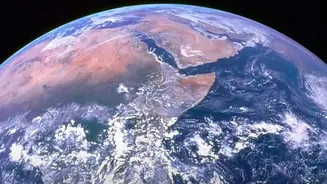
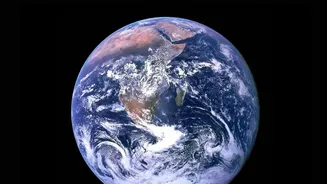
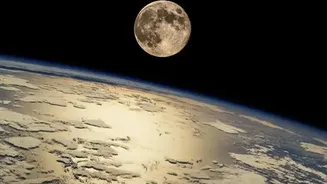
To ensure their methods are sound, scientists often treat Earth as if it were a distant exoplanet. By pointing instruments at our own planet from space, they can test how well they can detect its atmospheric composition, cloud cover, and signs of life from a great distance. This helps calibrate their tools and validate their models. It allows them to understand the challenges, such as how changing seasons or weather patterns might alter what a distant telescope sees. Before we can confidently claim to have found a habitable world hundreds of light-years away, we first have to prove we can correctly identify the properties of the one we are standing on.