


The Ocean’s Rainforests
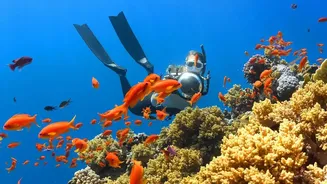
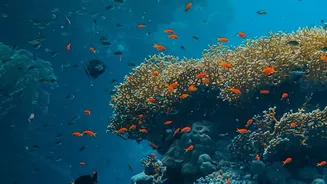
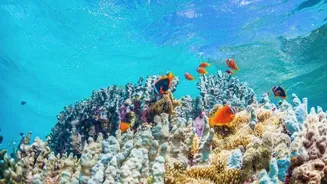
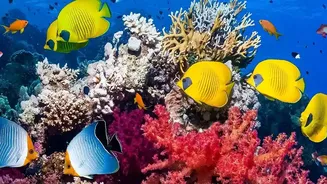
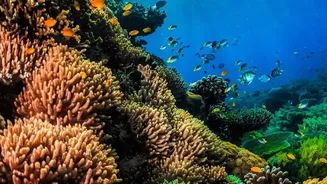
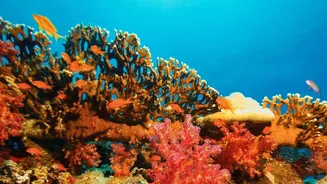
Often called the ‘rainforests of the sea’, coral reefs are among the most diverse and valuable ecosystems on Earth. Though they cover less than one percent of the ocean floor, they support an estimated 25% of all marine life. Thousands of species of fish,
invertebrates, and other organisms rely on reefs for food, shelter, and as nursery grounds. For humans, they provide billions of dollars in economic value through tourism and fisheries, and act as natural barriers that protect coastlines from storm surges and erosion. These intricate structures are not rocks or plants, but colonies of tiny animals that build the foundation for this immense biodiversity.
A World Losing Its Colour
The greatest threat to these ecosystems today is coral bleaching. This happens when ocean temperatures rise, stressing the coral. Corals have a symbiotic relationship with microscopic algae called zooxanthellae that live in their tissues. These algae are the coral's primary food source and give them their vibrant colours. When the water gets too hot, corals expel these algae. Without them, the coral's white skeleton becomes visible through its transparent tissue, making it look 'bleached'. A bleached coral is not dead, but it is starving and more vulnerable to disease. If temperatures remain high, the coral cannot recover its algae and will eventually die.
Harnessing Nature's Survivors
This is where thermal resilience comes in. It is the ability of a coral to resist or recover from heat-induced bleaching. Scientists have observed that even during mass bleaching events, some corals survive. This suggests they are naturally more tolerant to heat. The focus of intense research is to understand what gives these corals their edge. It could be their genetic makeup, or it could be related to the specific types of heat-tolerant algae they host. By identifying these resilient individuals, scientists see a potential lifeline for reefs worldwide.
Aiding Evolution in the Lab
Rather than just waiting for nature to take its course, which is likely too slow to keep pace with climate change, scientists are actively intervening through a process called 'assisted evolution'. This involves several innovative techniques. One is selective breeding, where researchers cross-breed naturally heat-tolerant corals to produce offspring with enhanced survival traits. Another method is 'stress-hardening', where corals are gradually exposed to higher temperatures in labs to acclimatise them and boost their resilience before being planted back in the ocean. Scientists are also working with the corals' symbiotic algae, culturing and evolving strains of zooxanthellae in the lab to be more heat-tolerant. These tougher algae can then be introduced to corals to improve their resistance to bleaching.
Saving More Than Just Corals
The focus on coral thermal resilience is fundamentally a strategy to save entire ecosystems from collapse. When a reef dies, the loss is catastrophic and extends far beyond the corals themselves. The complex, three-dimensional habitat they provide disappears, leading to a sharp decline in the abundance and diversity of fish and other species that depend on them. This has devastating consequences for the marine food web and for the hundreds of millions of people worldwide who rely on reefs for food and income. By working to create reefs that can withstand warmer waters, scientists are not just saving a single species; they are preserving the foundation of marine biodiversity and protecting the critical services these ecosystems provide.