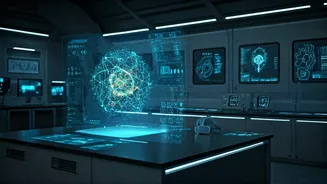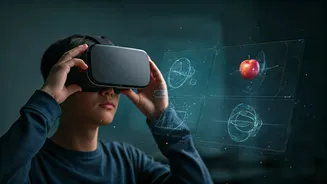






What is a VR Physics Lab?
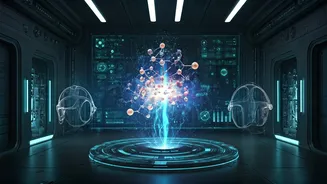
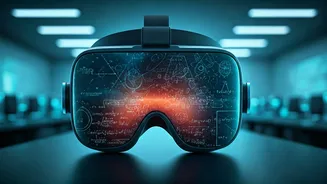
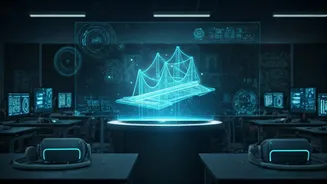
Forget rote memorization and two-dimensional diagrams. Immersive virtual reality (VR) physics experiments place students directly inside a simulated environment where the laws of physics are theirs to command. By donning a VR headset, a student is no
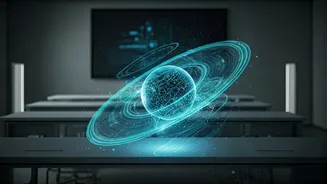
longer a passive observer but an active participant. They can 'hold' a light wave to see its properties, shrink down to the atomic level to witness chemical bonding, or even travel to the edge of a black hole to understand gravity's immense power. These are not pre-recorded videos; they are interactive sandboxes. Students can change variables, run experiments that would be impossible or hazardous in a real-world lab, and see the consequences of their actions in real-time, creating a powerful, intuitive connection to complex theories.
Making the Abstract Tangible
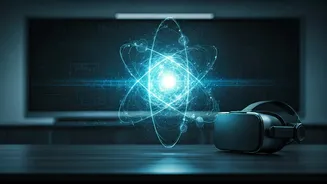
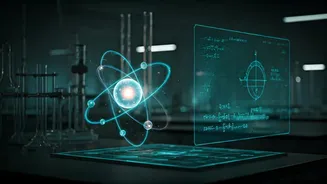
The greatest challenge in teaching physics has always been its abstract nature. Concepts like quantum mechanics, electromagnetism, and special relativity are difficult to visualize. Traditional methods rely on mathematical formulas and static illustrations, which can be alienating for many students. VR bridges this gap by transforming abstract equations into tangible experiences. When a student can physically walk around a virtual atom and observe electron orbits, the concept of quantum shells ceases to be just a term in a book. This kinesthetic learning—learning by doing—has been shown to dramatically improve information retention and conceptual understanding. It fosters curiosity and experimentation, allowing students to ask “what if?” and immediately see the result, a process that is fundamental to scientific thinking but often limited in a resource-constrained classroom.
The Great Equalizer: Safety and Access
Beyond engagement, VR labs solve two of the most persistent problems in science education: safety and access. Many crucial physics experiments involve hazardous materials, high voltages, or expensive, delicate equipment. A VR lab eliminates these risks entirely. Students can safely simulate nuclear reactions or work with high-powered lasers without any physical danger. Furthermore, this technology acts as a great democratizer. Most schools, especially in semi-urban and rural India, cannot afford a fully-equipped, modern physics laboratory with particle accelerators or advanced spectrometers. A single set of VR headsets, however, can provide access to a limitless array of virtual equipment, effectively giving every student a world-class laboratory at their fingertips. This levels the playing field, ensuring that a student’s access to quality science education isn’t limited by their school’s budget.
A New Horizon for Indian Education?
The potential for this technology within the Indian educational landscape is immense. With the government's push towards digital infrastructure through initiatives like Digital India and the National Education Policy (NEP) 2020 emphasizing experiential learning, the stage is set for a technological revolution in classrooms. Several Indian ed-tech startups are already exploring the VR/AR space, developing content tailored to the national curriculum. Imagine students in a remote village in Rajasthan learning about projectile motion by launching virtual cannons, or a class in Mumbai exploring the principles of fluid dynamics by building a virtual dam. VR can help overcome language barriers by providing visual, universal explanations for scientific phenomena, making quality STEM education more inclusive and widespread.
The Reality Check: Hurdles to Adoption
Despite the promise, widespread adoption is not without its challenges. The primary barrier remains cost. While prices are falling, high-quality VR hardware is still a significant investment for most schools. Beyond hardware, there is the need for robust internet infrastructure, teacher training, and a fundamental shift in pedagogy. Simply handing a teacher a VR headset is not enough; educators need to be trained on how to integrate these tools into their lesson plans effectively. There is also the challenge of creating high-quality, curriculum-aligned content that goes beyond novelty and delivers real educational value. Overcoming these hurdles will require a concerted effort from policymakers, tech companies, and educational institutions.