
The Challenge of Distant Worlds
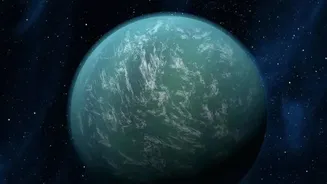
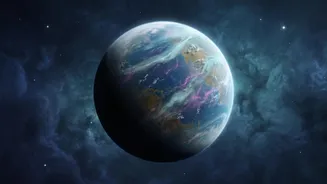
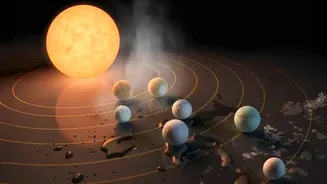
Observing a planet outside our solar system, an exoplanet, is an immense technical challenge. These worlds are incredibly faint and far away, often appearing as nothing more than a tiny dip in a star's brightness as they pass in front of it. Getting any
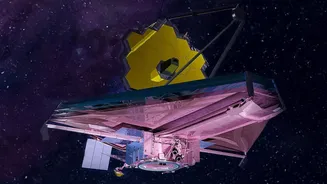
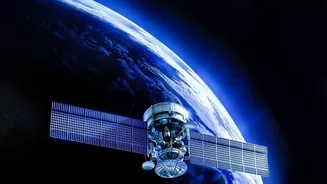
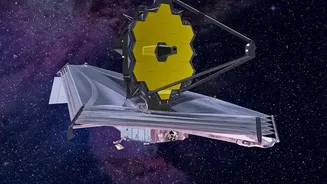
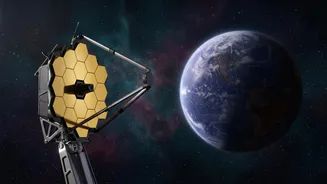
information, especially about their atmospheres, requires powerful tools like the James Webb Space Telescope (JWST). This telescope uses a technique called transmission spectroscopy, where it analyzes the starlight filtering through an exoplanet's atmosphere. The gases in that atmosphere absorb specific colors of light, leaving behind a unique chemical fingerprint or 'barcode' that scientists can read. But reading that barcode is only half the battle; the next, and perhaps harder, step is interpreting what it means.
Earth as a Scientific Blueprint
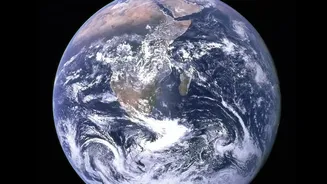
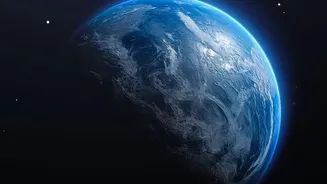
This is where our own planet becomes indispensable. Earth provides the ultimate ground truth for what a habitable, life-bearing planet can look like. Scientists use sophisticated computer simulations known as 'Exo-Earth System' models. These models, which are often adapted from the same ones used to predict Earth's climate, can simulate an Earth-like planet with different atmospheric compositions and climates. By inputting data from an exoplanet observation into these models, astronomers can test different scenarios. For instance, they can see if the observed chemical fingerprint matches a world with oceans and a nitrogen-oxygen atmosphere, or something far more alien. This allows them to move from simply listing the detected gases to building a picture of the planet's actual environment.
A Journey Through Time
Crucially, astronomers don't just model our modern Earth. Our planet's 4.5-billion-year history offers a library of different planetary states. For instance, the Archean Eon (4 to 2.5 billion years ago) saw an Earth with very little oxygen but high levels of methane. By studying the geological record and modeling this ancient Earth, scientists can understand what a hazy, pre-oxygenated but potentially habitable world might look like from afar. This historical perspective is vital because an alien world might not resemble Earth today, but it could resemble Earth a billion years ago. Looking at our planet's past helps scientists create a broader catalog of potential environments to compare against their observations, refining the search for life.
The Hunt for Biosignatures
The ultimate goal for many is to find biosignatures—gases or combinations of gases that strongly suggest the presence of life. On Earth, life produces a mix of gases, like oxygen and methane, that are in chemical disequilibrium, meaning they shouldn't exist together without a constant source, like biology, producing them. Earth models allow scientists to simulate what these biosignatures would look like in an exoplanet's spectrum. This helps them distinguish a true sign of life from a 'false positive,' where non-biological processes might mimic a biosignature. For example, a model might show that a certain amount of oxygen could be produced by sunlight splitting water vapor in the atmosphere, without any need for photosynthetic life. By running these simulations, astronomers can build confidence and assign a probability to whether a detected signal is truly from life.
Beyond the Blueprint
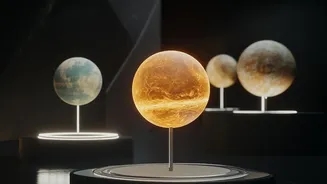
While Earth is an incredible guide, scientists are careful not to be too Earth-centric. Our planet is just one data point in a vast galaxy. The models must also account for conditions wildly different from our own, such as planets orbiting cooler, dimmer M-dwarf stars, which are the most common in the galaxy. These planets would experience different types of light and stellar activity, radically changing their atmospheric chemistry. The models are therefore constantly being adapted to explore these non-Earth-like scenarios. The goal is not just to find a mirror image of Earth, but to understand the full diversity of planets out there and to be prepared to recognize life even if it looks nothing like what we have at home.