


The Perfect Season for Stargazing
Autumn provides a sweet spot for skywatching. The sun sets earlier, meaning you don't have to stay up past midnight to enjoy a truly dark sky. The often turbulent and humid air of summer gives way to cooler, drier atmospheric conditions. This stability
means less twinkling and distortion, resulting in sharper, clearer views of the stars. It’s a comfortable compromise between the short, hazy nights of summer and the bone-chilling cold of deep winter, making it an inviting season to simply be outside and look up. Fewer insects and quieter surroundings also contribute to a more pleasant and focused observing experience.
Why Binoculars Are Your Best Friend
It might seem counterintuitive, but for many of the sky’s greatest treasures, binoculars are superior to a telescope. A telescope’s high magnification narrows your perspective, showing you a tiny, magnified patch of sky. Binoculars, on the other hand, offer a wide field of view. This is crucial for appreciating large star clusters and galaxies that would be cramped or cut off in a typical telescope view. They are intuitive to use—if you can look at a bird on a branch, you can aim them at the sky. Their portability means you can easily take them to a park or rural area with less light pollution, dramatically improving what you can see.
Must-See Target 1: The Andromeda Galaxy
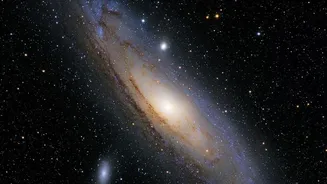
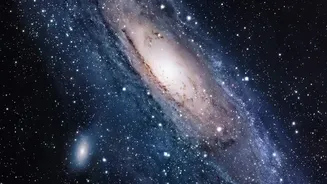
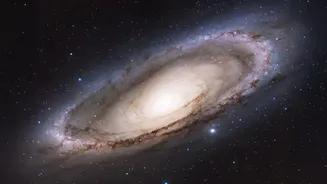
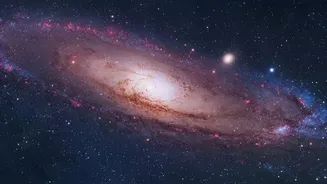
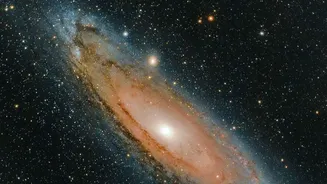
The undisputed crown jewel of the autumn sky is the Andromeda Galaxy, or M31. At 2.5 million light-years away, it is the most distant object you can see with your unaided eye, but only from a very dark location where it appears as a faint, fuzzy smudge. Through binoculars, it transforms. What was a barely-there patch becomes an obvious, glowing oval of light. You'll be able to clearly distinguish its brighter, concentrated core. To find it, first locate the W-shaped constellation of Cassiopeia or the Great Square of Pegasus. From there, you can star-hop over to Andromeda. Seeing the faint light of an entire galaxy, home to a trillion stars, is a humbling experience that never gets old.
Must-See Target 2: The Pleiades Star Cluster
Often mistaken for the Little Dipper, the Pleiades (or M45) is a stunning open star cluster in the constellation Taurus. To the naked eye, it looks like a tight, misty patch of six or seven stars, earning it the nickname the Seven Sisters. Point your binoculars at it, and the view explodes into dozens of glittering, blue-white stars. Because the cluster is so large in apparent size, binoculars are the ideal instrument for taking in the whole spectacle at once. A telescope would only show a small fraction of the group. The stars are relatively young, around 100 million years old, and their brilliant blue light makes them a breathtaking sight against the blackness of space.
More Autumn Wonders for Your Binoculars
The autumn sky is rich with other targets perfect for binoculars. The Double Cluster in Perseus is another showstopper, appearing as two distinct, glittering swarms of stars in a single field of view. Located between Cassiopeia and Perseus, it’s a favorite for its sheer beauty. You can also scan the band of the Milky Way, which is still prominent in the early autumn sky. Simply sweeping your binoculars through these dense star fields reveals a richness that is invisible to the naked eye. You'll also find other open clusters like M39 in Cygnus and asterisms like Poniatowski's Bull, both of which fit beautifully within a binocular view. Each sweep is a new adventure, revealing the dense, starry texture of our own galaxy.