







The Martian Air Problem
Sustaining a human presence on Mars is an immense logistical challenge, and the most fundamental obstacle is the air itself. The Martian atmosphere is about 100 times thinner than Earth's and is composed almost entirely of carbon dioxide, with only trace
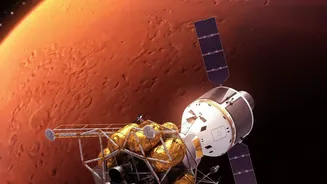
amounts of oxygen (about 0.13%). For astronauts to survive, they need a constant supply of breathable air. Furthermore, to return to Earth, their spacecraft will require a massive amount of liquid oxygen to serve as a propellant oxidizer. NASA estimates that lifting a crew of four off the Martian surface would require about 25 metric tons of oxygen. Transporting this much oxygen from Earth is prohibitively expensive and complex, requiring a staggering 500 tons of propellant to be launched into Earth orbit just to deliver the necessary oxygen to Mars. The sheer weight and cost make it a non-starter for any long-term, sustainable exploration program.
Living Off the Land
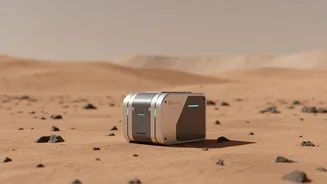
The solution lies in a principle that pioneers have used for centuries: living off the land. In space exploration, this is called In-Situ Resource Utilization (ISRU). Instead of packing everything you need, you use the resources available at your destination. On Mars, the most abundant resource is the carbon dioxide in the atmosphere. This is where carbon-dioxide reactors come in, designed to act like a mechanical forest, inhaling the toxic Martian air and exhaling pure, breathable oxygen. This technology is not just a convenience; it is a mission-enabler. By producing oxygen on-site, ISRU dramatically reduces the mass that needs to be launched from Earth, making human missions to Mars more feasible, affordable, and sustainable.
How the Oxygen Reactor Works
The core technology behind this process is called Solid Oxide Electrolysis (SOXE). It works by heating the Martian atmosphere to an extremely high temperature, around 800 degrees Celsius (1,470 degrees Fahrenheit). At this temperature, the carbon dioxide (CO2) molecules become unstable. The hot, compressed gas is then passed through a stack of ceramic electrochemical cells. These cells apply an electric current that effectively splits the CO2 molecules. It separates one of the oxygen atoms from the carbon dioxide, leaving behind carbon monoxide (CO) as a byproduct. The freed oxygen atoms, which are now ions, are pulled across a ceramic electrolyte membrane and combine on the other side to form pure, breathable oxygen (O2). The carbon monoxide is then harmlessly vented back into the Martian atmosphere.
MOXIE: A Toaster-Sized Proof of Concept
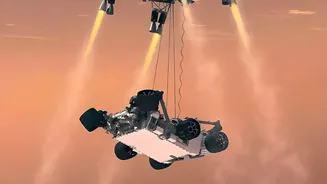
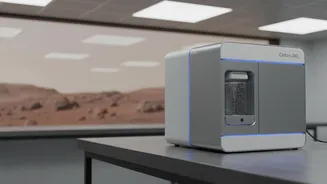
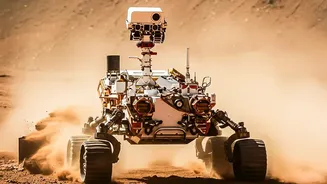
This technology is no longer theoretical. NASA's Perseverance rover, which landed on Mars in 2021, carried a remarkable instrument called the Mars Oxygen In-Situ Resource Utilization Experiment, or MOXIE. Built by MIT, the gold-plated, toaster-sized device was designed as a small-scale demonstration. On April 20, 2021, MOXIE made history by producing oxygen from the Martian atmosphere for the first time. During its mission, MOXIE ran 16 times in various Martian conditions, successfully producing a total of 122 grams of oxygen with a purity of 98% or better. At peak efficiency, it generated up to 12 grams of oxygen per hour, double its design goal. While that's only enough to keep a small dog alive for about 10 hours, MOXIE's success proved that the technology works in the harsh reality of the Martian environment.
Scaling Up for a Human Crew
The challenge now is one of scale. A full-scale system capable of supporting a human mission would need to be about 200 times larger than MOXIE and run continuously for over a year to produce the required 25-30 tons of oxygen for the return rocket. Such a system would likely weigh about a metric ton and require a significant power source, possibly a dedicated 25-30 kilowatt power plant, which could be nuclear or solar. Engineers are already working on the next generation of this technology. Companies like OxEon are developing mission-scale SOXE stacks that are over 30 times more powerful than the device in MOXIE. The plan is to send a full-scale oxygen plant to Mars on a precursor mission, letting it churn out and store oxygen for more than a year before the first astronauts even begin their journey.