



More Than Just Dust
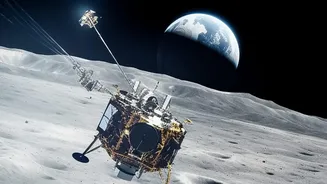
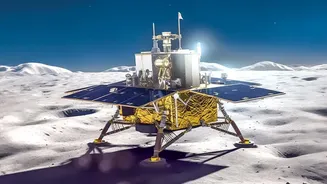
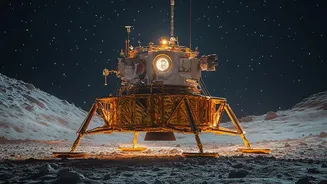
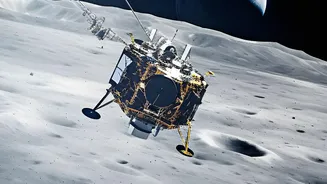
When the Vikram lander touched down near the Moon’s south pole on August 23, 2023, it marked a monumental achievement for India. But the mission was just beginning. Now, scientists from the Physical Research Laboratory (PRL), Ahmedabad, have analysed
data from the lander and uncovered a secret hidden just beneath the surface. According to a study published in the 'Nature Portfolio' journal 'npj Space Exploration', the ground at Shiv Shakti Point is not a simple pile of dust. Instead, it consists of three distinct layers within the top 10 centimetres, each with different properties. This fine-scale layering was unexpected and provides an unprecedented look at the geology of the lunar south pole. The findings are based on observations from one of Vikram’s key instruments, the Chandra’s Surface Thermophysical Experiment, or ChaSTE.
A Three-Layered Profile
The ChaSTE instrument, a probe designed to penetrate the lunar surface and measure its thermal properties, painted a detailed picture of the soil, more formally known as regolith. The analysis revealed a top layer, extending down about 3 cm, that is highly porous—almost fluffy—with a low density. Below this lies a middle layer, from 3 to 6 cm deep, which is more compacted and conducts heat more effectively. The third layer, between 6 and 10 cm, is even denser, though its thermal conductivity is intermediate between the top two. The density of the soil increases significantly with depth, from about 600 kg per cubic metre at the surface to 1,500 kg per cubic metre just 10 cm down. This layered structure had not been observed with such clarity before, offering the first direct thermophysical profile of this lunar region.
How The Discovery Was Made
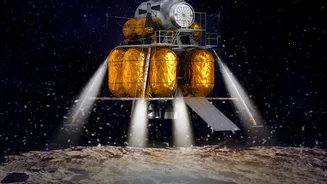
The ChaSTE probe played the central role in this discovery. It is essentially a high-tech rod equipped with temperature sensors and a heater, which was carefully inserted into the regolith. By heating the soil and measuring how the temperature changed at different depths, scientists could determine properties like thermal conductivity and density. The new three-layer discovery actually builds on an earlier finding. After its initial experiments, the Vikram lander performed a remarkable 'hop' manoeuvre, firing its engines to lift off and land again about 50 cm away. The engine blast blew away the top layer of loose dust at the new spot, exposing the compacted soil underneath and initially revealing a two-layer structure. The latest study analyses data from the original, undisturbed landing site, completing the picture by characterising the extremely porous top layer that was blown away during the hop.
Clues to the Moon's Past
So, what created these layers? Scientists believe they are a record of the Moon's turbulent history. The lunar surface is constantly bombarded by micrometeorites. Researchers suggest that successive impact events from nearby craters may have thrown out and deposited material with different characteristics over long periods, creating this stratified, cake-like structure. Furthermore, the layers respond differently to the extreme temperature swings on the Moon. At local noon, the ChaSTE probe recorded a dramatic temperature difference of about 73 Kelvin across the top 10 cm. Understanding this thermal behaviour is not just an academic exercise; it provides crucial clues about how the Moon's surface has been shaped and altered by its environment over billions of years.
Paving the Way for Future Exploration
These findings have profound implications for the future of lunar exploration. The south pole is a region of immense interest, partly because of the potential for water ice in permanently shadowed craters. Any future mission that aims to establish a long-term presence, build habitats, or extract resources will need to know exactly what the ground is like. This study reveals that the soil's properties, like its density and cohesiveness, change significantly within just a few centimetres. Knowing that the regolith has a strong, grippy layer just beneath a fluffy surface is critical for designing rovers that won't get stuck and foundations for structures that will be stable. This detailed knowledge of the ground beneath our feet—or wheels—is essential for turning the dream of a lunar base into a reality.