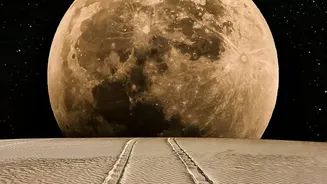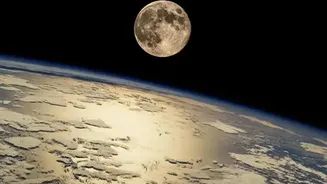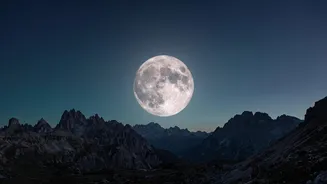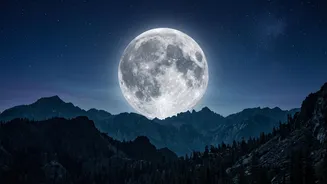

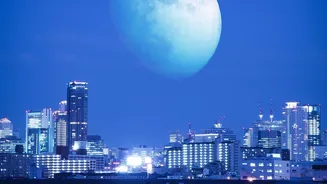

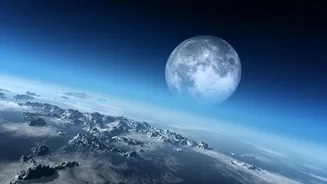
We've all seen it: a full moon rising over a city skyline or a string of distant hills, looking impossibly large. It’s a stunning, almost cinematic moment. But here’s the secret: it’s all in your head. It's a powerful and ancient optical illusion.
An Illusion for the Ages
First,
let's get one thing straight: the moon isn't actually bigger. If you were to measure its angular size with a scientific instrument, you’d find it remains almost perfectly consistent whether it's grazing the horizon or shining directly overhead. In fact, due to the geometry of our position on a spherical Earth, the moon is technically about 1.5% farther away—and thus slightly smaller—when it's on the horizon compared to when it's at its highest point in the sky. So if it isn't a physical change, what's going on? The phenomenon, known as the Moon Illusion, has been debated since ancient times, but modern science points to a fascinating glitch in our visual processing system. It’s not your eyes that are being fooled, but your brain.
The Brain's Flawed Sizing Chart
Your brain is constantly working to make sense of the world, and it has a clever shortcut for judging an object's size: it factors in perceived distance. This is called the 'apparent distance hypothesis'. Think of it like this: if two cars are in your line of sight and both project the same-sized image onto your retina, but you know one is a block away and the other is a mile away, your brain correctly concludes the farther car must be much larger. It automatically scales up its perceived size to account for the distance. This mental calculation works wonderfully for navigating our terrestrial environment, but it goes haywire when we look at the sky. This is also related to the classic Ponzo illusion, where two identical lines placed on converging tracks appear to be different sizes because our brain uses the 'tracks' as a cue for distance.
It's All About the Scenery
This is where the 'terrain elements' from the headline come in. When the moon is low on the horizon, it’s framed by objects we understand: trees, buildings, mountains. Our brain sees this landscape receding into the distance and correctly identifies it as being far away. Because the moon appears behind or among these distant objects, our brain applies its usual logic: 'That moon is way out there with those faraway hills, so it must be gigantic!'. It's forced to 're-scale' the moon to an enormous size to make sense of a scene filled with depth cues. Your brain is essentially interpreting the moon as just another object on the landscape, subject to the normal rules of perspective.
The Emptiness of the Zenith
Now, contrast that with the moon at its zenith, high in the vast, empty night sky. Up there, there are no trees, buildings, or other reference points. Without these terrestrial cues, your brain has nothing to compare the moon to. The sky overhead doesn't feel miles deep; it feels like a closer, flattened dome. Lacking any information to suggest great distance, your brain defaults to a 'closer' setting. And since the image on your retina is the same size, the mental calculation changes. Your brain thinks: 'This object is closer, so it must be smaller.' The grand illusion evaporates, and the moon shrinks back to its 'normal' size, all because the familiar, object-filled terrain has been replaced by a blank canvas.