



An Ambitious Journey to an Ocean World
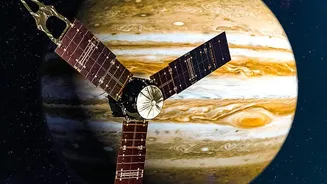
Launched on October 14, 2024, the Europa Clipper is the largest interplanetary spacecraft ever built by NASA. Its destination is the Jupiter system, a journey that will take five and a half years and cover approximately 1.8 billion miles. To get there,
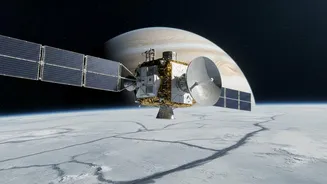
it’s not taking a direct route. The spacecraft is performing a series of gravity assists, using the gravitational pull of Mars (in March 2025) and Earth (in December 2026) to slingshot itself toward the outer solar system. Upon its arrival in April 2030, the Clipper will not orbit Europa directly due to Jupiter’s intense radiation belts. Instead, it will enter a long, looping orbit around Jupiter, making dozens of close flybys of Europa over four years. These passes will bring the spacecraft as close as 16 miles (25 kilometers) to the moon's surface, allowing for an unprecedentedly detailed survey.
Why Europa Is So Compelling
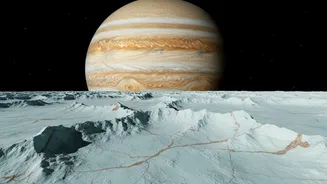
Scientists are fascinated by Europa because it shows strong evidence of a global ocean of liquid saltwater hidden beneath its icy shell. This ocean may contain more than twice the volume of all of Earth's oceans combined. The moon's surface, which is colder than any place on Earth, is covered in an ice shell estimated to be 10 to 15 miles thick. What makes this ocean world so promising is the potential for three key ingredients for life as we know it: liquid water, essential chemical elements, and a source of energy. The energy may not come from sunlight, but from tidal heating. Jupiter's immense gravity constantly squeezes and flexes Europa, generating heat within the moon and keeping its ocean from freezing solid. This process could also drive activity on the seafloor, potentially creating hydrothermal vents similar to those on Earth that support rich ecosystems.
A Toolkit for Astrobiological Discovery
To peer beneath the ice and understand Europa's environment, the Clipper is equipped with a sophisticated suite of nine scientific instruments. These tools are protected inside a robust aluminum-titanium vault to shield them from Jupiter's harsh radiation. Key instruments include the REASON radar, designed to penetrate the ice shell and confirm the ocean's existence while searching for pockets of water within the ice. Spectrometers like MISE and Europa-UVS will map the chemical composition of the surface, looking for salts and organic compounds that could give clues about the ocean below. Other instruments, such as the magnetometer, will measure the depth and salinity of the ocean by analyzing Europa’s magnetic field. The spacecraft will also carry dust and gas analyzers, which could directly sample material if it flies through one of the water vapor plumes that scientists believe may erupt from Europa's surface.
Seeking Habitability, Not Hunting for Aliens
While the headline-grabbing goal is the search for life, NASA is very clear that Europa Clipper is not a life-detection mission. Its primary objective is to investigate Europa's habitability—that is, to determine whether the conditions exist that could support life. This is a crucial distinction. The mission is designed to answer foundational questions: How thick is the ice shell? How salty is the ocean? Are there organic materials available? Is there an exchange of material between the surface and the ocean below? Finding the right ingredients for life would be a monumental discovery in itself. It would tell scientists that Europa is a habitable environment and pinpoint the most promising locations for a future mission, such as a lander, to search for direct evidence of life.