



The Sun’s Restless Heartbeat
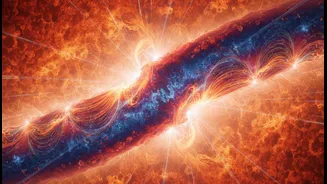
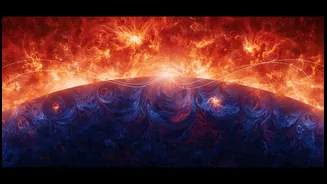
Our star isn't the static, unchanging ball it appears to be. It operates on an approximately 11-year cycle of activity, moving from a quiet period (solar minimum) to a turbulent one (solar maximum) and back again. This cycle is defined by the appearance
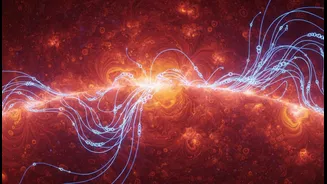
of sunspots, which are darker, cooler areas on the Sun's surface that are hotbeds of intense magnetic activity. These active regions are the source of solar flares and coronal mass ejections (CMEs)—massive eruptions of energy and particles that travel through space. When directed at Earth, these events create what we call 'space weather', which can endanger astronauts, disrupt GPS and communication satellites, and even damage power grids on the ground. For decades, predicting the timing and intensity of these solar cycles has been a monumental challenge for scientists.
A Journey to the Solar Interior
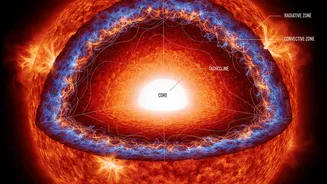
To understand the Sun's surface, scientists have to look deep inside. The Sun has distinct layers: a core where nuclear fusion occurs, a radiative zone where energy travels as light, and an outer convection zone where hot plasma churns like boiling water. Between the calm radiative zone and the turbulent convection zone lies a remarkably thin but critical boundary layer called the tachocline. For years, its thinness has been a major puzzle. Think of it as a cosmic shear layer. The radiative interior rotates as a solid body, while the convection zone above it rotates at different speeds—faster at the equator than at the poles. The tachocline is where these two different rotation styles meet, creating immense stress. It's believed this is where the Sun's powerful magnetic field is generated and amplified—a process known as the solar dynamo.
Meet the COFFIES Project
Enter COFFIES, which stands for 'Consequences Of Fields and Flows in the Interior and Exterior of the Sun'. It's a multi-institutional science center funded by NASA with a clear mission: to build comprehensive models that explain how the plasma flows inside the Sun create its magnetic activity cycles. For too long, scientific models struggled to explain why the tachocline was so thin and stable. By bringing together experts and using state-of-the-art computer simulations, the COFFIES team set out to crack this fundamental mystery and connect the dots between the Sun's interior dynamics and the space weather that affects us all.
The Breakthrough Connection
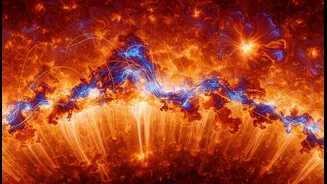
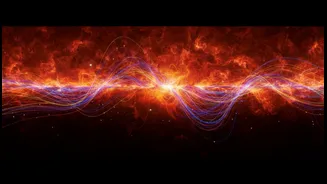
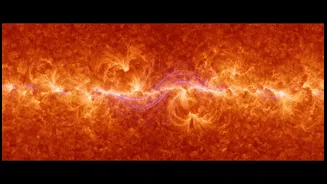
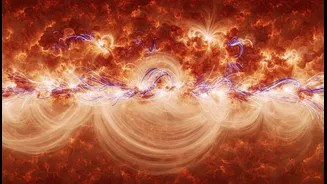
The latest COFFIES research has delivered a major breakthrough. Using highly refined computer models, the team discovered a two-way relationship that maintains the tachocline's structure. Their simulations showed that the tachocline is essential for driving the solar dynamo, the engine that powers the Sun's magnetic field. In turn, the constantly fluctuating magnetic field it creates helps to confine the tachocline, keeping it thin. Most importantly, the research establishes a direct link between these deep flows and surface events. It shows how the magnetic field, amplified and organized within the tachocline, eventually rises to the surface to form the sunspots and active regions we observe. This confirms the tachocline as the main staging ground for solar activity.
Better Forecasts for Space Weather
This discovery isn't just an academic achievement; it has profound practical implications. By understanding the fundamental mechanisms that generate magnetic activity deep inside the Sun, scientists can build far more accurate models for predicting the solar cycle. Improved long-range forecasts for space weather would be a game-changer. It would give satellite operators, power grid managers, and space agencies crucial lead time to protect their assets from damaging solar storms. Actions could include putting satellites into a safe mode or taking sensitive electrical systems offline to prevent catastrophic failures. While we're not yet at the stage of a daily space weather report on the evening news, this research is a critical step toward that future, making our technologically-dependent society more resilient to the Sun's inevitable outbursts.