






A World Called 55 Cancri e
The planet at the centre of this discovery is 55 Cancri e, also known as Janssen. Located 41 light-years away, it’s classified as a super-Earth — a rocky world significantly larger and more massive than our own, but smaller than gas giants like Neptune.
Don't picture a bigger version of our home, though. 55 Cancri e orbits its star at a blistering proximity, about 25 times closer than Mercury is to our Sun. It completes a full year in less than 18 hours. This extreme closeness means its surface is likely a bubbling ocean of molten magma, with temperatures hot enough to melt rock. For years, scientists have debated whether a planet under such an intense barrage of heat and radiation could possibly hold onto an atmosphere. Previous observations were inconclusive, but JWST is finally providing some answers.
How Webb Reads Alien Air
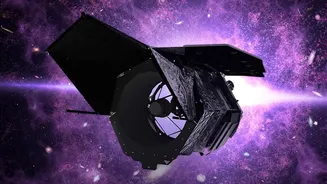
The James Webb Space Telescope can't take a direct picture of 55 Cancri e. Instead, it uses a clever technique involving its powerful infrared instruments, NIRCam and MIRI. Scientists wait for the planet to pass behind its star, an event called a 'secondary eclipse'. They measure the total light from the system when both the star and planet are visible, and then measure the light from just the star when the planet is hidden. By subtracting one from the other, they can isolate the faint infrared light, or heat, coming from the planet’s dayside itself. This light holds the chemical fingerprints of any gases that might be present. Different molecules in an atmosphere absorb specific wavelengths of light, and by analysing this 'spectrum,' astronomers can deduce what the atmosphere is made of.
A Secondary, Steamy Atmosphere
The findings suggest 55 Cancri e is shrouded in a substantial atmosphere, likely rich in carbon dioxide and carbon monoxide. The data also indicates the presence of other volatiles, including water vapour. This isn't a primordial atmosphere that the planet has held onto since its formation. That would have been stripped away by the star's intense radiation long ago. Instead, scientists believe this is a 'secondary' atmosphere that is being constantly replenished from the planet's interior. The idea is that the vast magma ocean is continuously releasing dissolved gases, which bubble up to the surface and feed the atmosphere. In a strange twist, the very thing that makes the planet so inhospitable—its molten surface—may be the key to it retaining an atmosphere against all odds.
Not Habitable, But Still Huge News
With a surface of molten rock, 55 Cancri e is clearly not a candidate for life as we know it. So why is this discovery so important? It represents the best evidence to date for a substantial atmosphere around any rocky exoplanet outside our solar system. It proves that even under the most extreme conditions, a rocky world can maintain a blanket of gas. This discovery pushes the frontiers of our technological capabilities and changes our understanding of planetary evolution. It provides a crucial test case for theories about how rocky planets gain, lose, and recycle their atmospheres. Before we can search for biosignatures on Earth-like worlds, we first need to understand the fundamental processes that allow any rocky planet to have air at all.