





A New Eye on the Cosmos
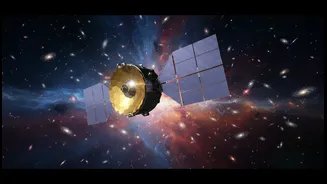
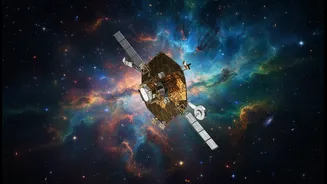
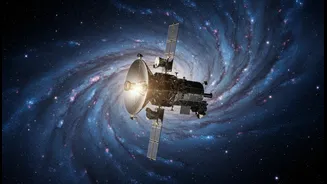
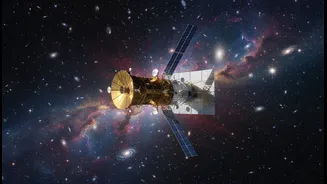
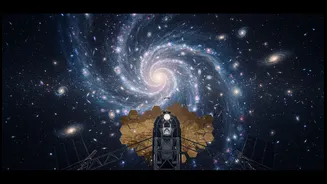
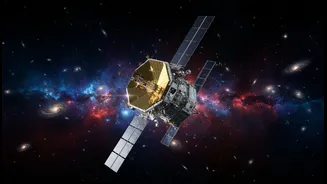
The Nancy Grace Roman Space Telescope, named after NASA's first chief of astronomy, is a next-generation observatory designed to unravel the secrets of dark energy, dark matter, and exoplanets. While it shares a primary mirror of the same 2.4-meter size
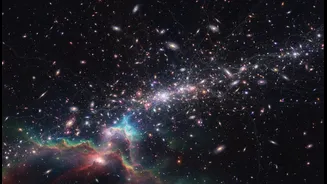
as the Hubble Space Telescope, its capabilities are vastly different. Roman is engineered for cosmic surveys, equipped with a Wide Field Instrument (WFI) that provides a field of view at least 100 times larger than Hubble's infrared camera. This means that where Hubble provides a keyhole look at the universe, Roman will deliver a panoramic vista. In a single shot, it can capture an area of the sky with the same exquisite detail as Hubble, but on a scale that would take Hubble hundreds of individual images to match. This survey power will allow astronomers to map the universe with unprecedented speed and scale.
Hunting for Cosmic Mysteries
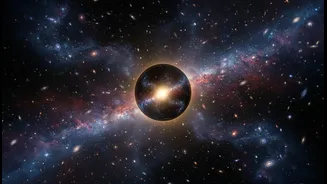
Approximately 95% of the universe is composed of dark energy and dark matter, mysterious components that we can't see or directly measure. Roman’s primary mission is to shed light on these phenomena. It will investigate dark energy—the enigmatic force causing the universe's expansion to accelerate—using three distinct methods: studying Type Ia supernovae, measuring baryon acoustic oscillations (relics of sound waves from the early universe), and analyzing weak gravitational lensing. By observing thousands of distant supernovae, which act as cosmic mile-markers, Roman can chart the expansion history of the universe with incredible precision. Furthermore, by studying how the gravity of dark matter distorts the light from distant galaxies—a phenomenon called weak lensing—the telescope will create vast maps of this invisible substance, revealing how cosmic structures have grown and evolved over time.
A Census of New Worlds
While the James Webb Space Telescope excels at studying the atmospheres of individual planets, Roman is built to find them in staggering numbers. The mission is expected to discover as many as 100,000 exoplanets using the transit method, where it watches for the slight dimming of a star as a planet passes in front of it. But its real game-changer is its use of a technique called gravitational microlensing. This method relies on the chance alignment of two stars from our viewpoint. The gravity of the foreground star acts as a natural lens, magnifying the light of the background star. A planet orbiting the foreground star creates an additional, brief spike in the light, revealing its presence. Microlensing is sensitive enough to find planets with masses as low as Mars, and at a wide range of orbits, including 'rogue planets' that drift through space without a host star. This will provide a statistical census of planets across our galaxy, helping scientists understand how common systems like our own truly are.
A Technology Powerhouse
Beyond its main survey camera, Roman carries a technology demonstration called the Coronagraph Instrument. A coronagraph is designed to block the overwhelming glare of a star, allowing the faint light of orbiting planets to be seen directly. This is an incredibly difficult technical challenge, akin to spotting a firefly next to a searchlight from thousands of miles away. Roman's coronagraph will be a crucial testbed for technologies that could be used on future missions designed to find and characterize Earth-like planets in the habitable zones of nearby stars. If successful, it will pave the way for observatories that could one day search for signs of life in the atmospheres of other worlds. The mission is currently scheduled to launch on a SpaceX Falcon Heavy rocket from Kennedy Space Center in Florida.