








The Problem We All See
During heavy monsoon showers or intense cloudbursts, our cities often grind to a halt. Streets in Mumbai, Delhi, Bengaluru, and Chennai become waterlogged, disrupting traffic and daily life. The immediate assumption is that the sheer volume of water has
overwhelmed our drainage systems, or that drains are clogged with plastic and silt. While these are significant factors, they don't tell the whole story. There is a less visible, more powerful force at play that dramatically reduces the efficiency of our stormwater infrastructure at the exact moment we need it most.
Introducing the Hidden Culprit: Trapped Air
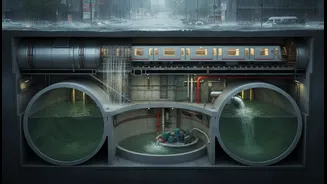
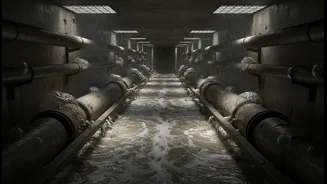
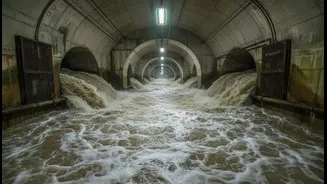
Beneath our cities lies a vast network of stormwater pipes. Before a storm, these pipes are not empty; they are full of air. When heavy rain begins, a massive volume of water rushes into these drains, trying to displace the air. Think of it like trying to fill a bottle with a narrow neck by holding it directly under a fast-running tap. The water struggles to get in because the air inside has no easy way to get out. In the same way, the sudden influx of rainwater into storm drains compresses the air already in the pipes, creating pockets of high pressure. This trapped air becomes a stubborn, invisible barrier.
How Air Fights Water—And Wins
This compressed air effectively creates an 'air lock' within the drainage system. The pocket of pressurised air acts like a plug, pushing back against the incoming water and drastically reducing the pipe's capacity to carry water away. Studies have shown that this phenomenon can reduce a drain's efficiency to a fraction of what it was designed for. In extreme cases, the pressure becomes so great that it seeks a violent escape. This results in what engineers call 'geysering'—explosive eruptions of air and water from manholes. These events are powerful enough to blow heavy manhole covers several feet into the air, posing a serious risk to pedestrians and vehicles.
A Modern Urban Challenge
The problem of trapped air is magnified by modern urban development. The proliferation of concrete and asphalt creates vast impermeable surfaces. Unlike soil, these surfaces do not absorb water. As a result, nearly all the rainwater becomes surface runoff, channelled directly into drainage systems almost instantaneously. This rapid, high-volume flow is precisely what causes air to become trapped and compressed. Our aging infrastructure, often designed for different rainfall patterns, simply cannot cope with the dual pressures of increased water volume and the resulting air compression, leading to the recurrent flooding we see in our cities.
Smarter Designs for a Wetter Future
Fortunately, engineers and urban planners are developing solutions. The key is to design systems that allow air to escape as water enters. This can include installing ventilation shafts at strategic points in the network to release air pressure safely. Other solutions involve designing special inlets that allow for two-way flow, where air can exit as water enters. On a larger scale, the concept of 'sponge cities' is gaining traction. This involves creating more green spaces, permeable pavements, and rain gardens that absorb rainwater naturally, reducing the burden on the piped network. Initiatives like the Atal Mission for Rejuvenation and Urban Transformation (AMRUT) are already focusing on upgrading storm water drainage in Indian cities.