


Meet the Cosmic Misfit Next Door
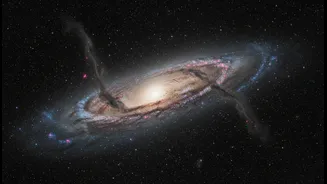
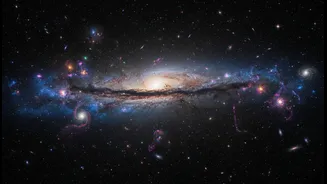
Imagine a galaxy that looks like it got dressed in the dark. That’s Centaurus A. From our viewpoint on Earth, it resembles a giant, glowing orb of stars sliced in half by a thick, dark belt of dust. For years, this strange appearance puzzled astronomers.
We now know its peculiar look is the result of a violent cosmic merger. Sometime around two billion years ago, a large elliptical galaxy collided with and consumed a smaller spiral galaxy. The dramatic dust lane we see is the mangled, leftover skeleton of that unfortunate spiral galaxy. At a distance of roughly 11 to 13 million light-years, Centaurus A is our closest major galactic neighbour that has an active supermassive black hole at its core, making it an object of intense fascination and study. It’s a natural laboratory for cosmic chaos, conveniently located in our cosmic backyard.
A Monster at the Heart of the Matter
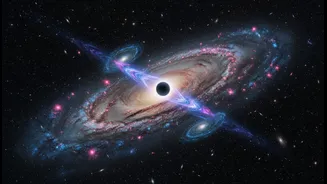
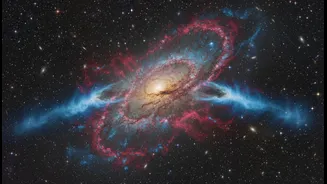
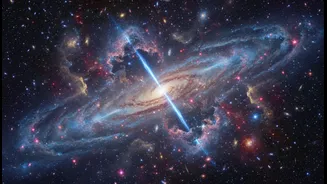
At the centre of this galactic wreckage lies a monster: a supermassive black hole packing the mass of 55 million suns. But this isn't a quiet giant. It's an active galactic nucleus (AGN), which means it's furiously feeding on the gas and dust swirling around it. As it feasts, it unleashes unimaginable amounts of energy, most famously in the form of two colossal jets of high-energy particles. These jets are blasted out in opposite directions, travelling at nearly half the speed of light. While the galaxy itself is visible to the eye through a telescope, these jets are so energetic that they make Centaurus A one of the brightest sources of radio waves in the night sky. In radio images, the jets stretch over a million light-years into space, dwarfing the galaxy they originate from. This immense power output profoundly shapes the galaxy, influencing where and when new stars can form.
Webb Pulls Back the Dusty Curtain
For all we knew about Centaurus A, its very heart remained shrouded in mystery, hidden behind those thick curtains of dust. Telescopes like Hubble, which see in visible light, couldn't peek behind the veil. Now, new images released to celebrate the James Webb Space Telescope’s fourth year of science have changed everything. Using its powerful mid-infrared vision, Webb has pierced through the obscuring dust to give us our clearest view ever of the galaxy’s core. The images are stunning, revealing a complex web of glowing, intricate filaments and warm dust clouds that were previously invisible. For the first time, Webb’s sharp resolution allows astronomers to resolve millions of individual stars glittering within the galaxy’s central region, offering a star-by-star account of its history.
Reading the Scars of a Galactic Crash
The new Webb data is more than just a pretty picture; it’s an astronomical treasure map. By tracing these newly revealed structures, scientists can better reconstruct the galaxy’s violent past. The aftermath of the ancient collision is written across the entire system, from its warped shape to the ongoing bursts of star formation triggered by the shockwaves of the merger. Webb's observations reveal how the black hole's energy output interacts with the surrounding gas, both compressing it to spark the birth of new stars and blasting it away to halt star formation elsewhere. It’s a dynamic, cosmic tug-of-war. The details captured by Webb provide a vivid record of this interplay, showing how a single cataclysmic event and a hungry black hole can continue to shape a galaxy's destiny for billions of years.
Why This Cosmic Chat Matters
Studying a galaxy 11 million light-years away might seem abstract, but it helps us answer some of the most fundamental questions about the universe, including our own place in it. Galaxies aren't static islands of stars; they grow, collide, and evolve. Centaurus A is our best nearby example of these processes in action. Understanding how its supermassive black hole co-evolved with its host galaxy provides a model for how countless other galaxies, including ones in the distant, early universe, may have formed. Each new detail helps astronomers refine their theories on everything from black hole physics to the life cycle of stars. With the new clarity provided by the Webb telescope, Centaurus A isn't just a peculiar object anymore. It’s actively talking to us, sharing the secrets of its turbulent past and offering a front-row seat to the forces that shape the cosmos.