

Spotting a Cosmic Ghost
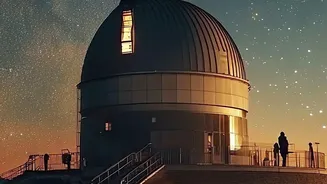
The first challenge is detection. Interstellar objects are faint, fast, and exceptionally rare. The discovery of 3I/ATLAS on July 1, 2025, was made possible by the Asteroid Terrestrial-impact Last Alert System (ATLAS), a NASA-funded survey. This system
uses robotic telescopes to scan the night sky repeatedly, taking pictures and looking for anything that moves. Sophisticated software compares these images, flagging potential new objects. Most are asteroids or comets from within our solar system, but occasionally, an object stands out. For 3I/ATLAS, its sheer speed and unusual path were the initial red flags that alerted astronomers they had found something truly special—a traveler from beyond the Sun's gravitational grip. The discovery was made by the ATLAS telescope in Chile, highlighting the global nature of planetary defense and astronomical research.
The Telltale Trajectory
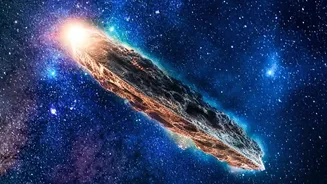
Once an object is spotted, the most crucial piece of evidence for its interstellar origin is its path, or trajectory. Objects belonging to our solar system are gravitationally bound to the Sun, moving in elliptical orbits. Think of it like a ball on a string being swung around a central point. Interstellar visitors, however, are moving too fast to be captured by the Sun's gravity. They follow what is known as a hyperbolic trajectory—a distinct, open-ended curve that proves they are just passing through. Astronomers calculate this trajectory by taking multiple observations of the object's position over days and weeks. For 3I/ATLAS, its high velocity and unbound path confirmed it did not originate from our solar system's Oort cloud or Kuiper belt, but from the vast expanse of interstellar space.
Decoding its Chemical Fingerprint
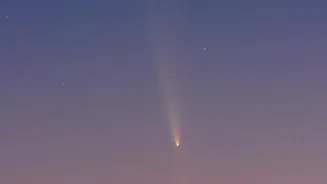
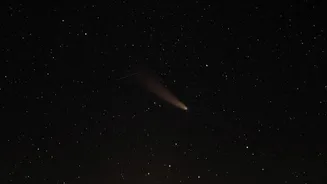
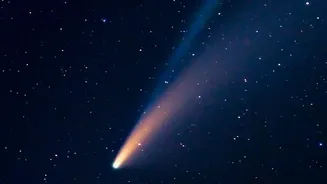
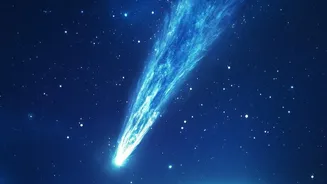
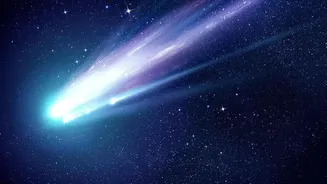
Knowing it's from another star system is one thing; knowing what it’s made of is another. This is where spectroscopy comes in. As 3I/ATLAS neared our Sun, its surface ice began to heat up and vaporize, creating a fuzzy atmosphere called a coma and a tail. Scientists point powerful telescopes, like the Very Large Telescope and the Hubble Space Telescope, at this coma. A device called a spectrograph then breaks the comet's faint light down into its constituent colours, like a prism creating a rainbow. Different chemical elements and molecules absorb and emit light at specific, known wavelengths, creating a unique barcode or 'fingerprint'. By analysing this spectrum, astronomers can identify the presence of materials like water, dust, cyanide gas, and even atomic nickel, comparing its composition to comets from our own solar system.
A Glimpse of a Distant World
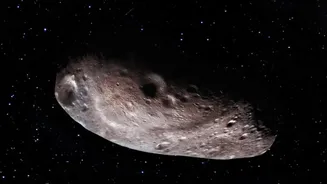
Every piece of data, from the comet’s size to its rate of outgassing, offers clues about its home. Observations of 3I/ATLAS suggest its nucleus is relatively small, perhaps less than a few kilometres in diameter. The types and amounts of gases it releases tell a story about the conditions in the protoplanetary disk where it originally formed, billions of years ago. For example, the ratio of different elements can suggest how far from its parent star it formed. Because 3I/ATLAS appears similar to comets from our own system, it suggests the building blocks for planets might be quite common across the galaxy. Studying these messengers gives scientists a rare, direct sample of material from another star system, helping us understand how planets—and perhaps life—might form elsewhere in the cosmos.