


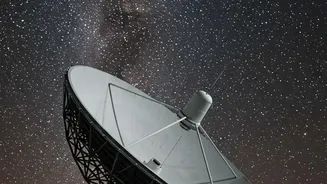
Listening to the Universe's Echo
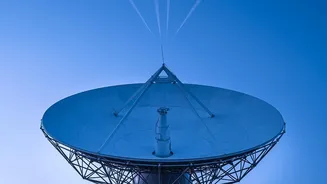
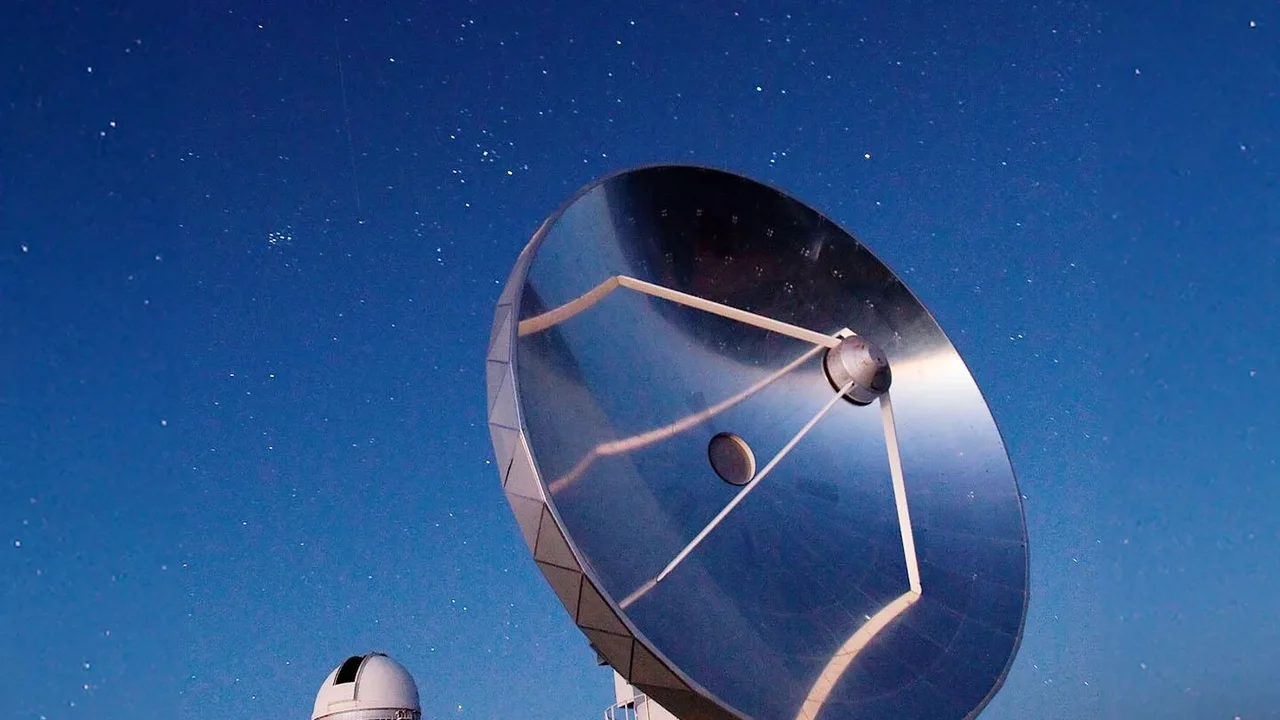
Unlike optical telescopes that see the light from stars and galaxies, radio telescopes are designed to 'hear' the universe. They detect radio waves, a form of invisible light emitted by cosmic phenomena like forming stars, black holes, and vast clouds
of gas. These signals can travel for billions of years across the expanding universe, carrying secrets from a time long before our planet existed. The challenge is that by the time these ancient signals reach Earth, they are incredibly faint—a billion billion times weaker than a mobile phone signal. To catch these whispers, you need an exceptionally large and sensitive 'ear'. This is the fundamental principle behind the SKA project, a global effort to build the world's largest and most powerful radio observatory.
The Power of Many: Interferometry
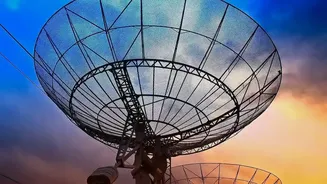
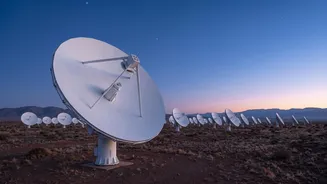
Building a single radio dish large enough for this task is physically impossible. Instead, the SKA uses a technique called interferometry. It combines the signals from thousands of antennas spread over vast distances, linking them with fibre optic cables to function as one gigantic virtual telescope. The SKA is actually two telescopes: SKA-Low in Western Australia, which will consist of over 131,000 Christmas tree-like antennas, and SKA-Mid in South Africa, which will feature 197 traditional-looking dishes. The farther apart the antennas are, the finer the detail they can resolve, effectively creating a high-resolution zoom lens on the cosmos. For this to work, the signals from every antenna must be perfectly synchronized using atomic clocks, ensuring all data can be precisely combined.
Capturing Signals from the 'Cosmic Dawn'
One of the SKA's primary missions is to study a mysterious period known as the Epoch of Reionization (EoR), the universe's 'cosmic dawn'. This was the era, about a billion years after the Big Bang, when the first stars and galaxies lit up and began to ionize the neutral hydrogen gas that filled the universe. The SKA is tuned to detect the faint radio signal emitted by this neutral hydrogen, which has a specific wavelength of 21cm. As the universe has expanded over billions of years, this signal has been stretched to much longer wavelengths—the very low-frequency radio waves that the SKA-Low telescope in Australia is designed to capture. By mapping this signal, astronomers will be able to create 3D images of the early universe, watching as the first cosmic structures were born.
From Signal to Science: A Data Tsunami
Capturing the signals is only half the battle. Each SKA dish and antenna collects a torrent of raw data. This information is digitized and sent via fibre optic links to a Central Signal Processor, the 'brain' of the telescope that begins the process of combining the signals from all the individual antennas. The sheer volume of data is staggering, requiring two of the world's most powerful supercomputers—one in Perth for SKA-Low and one in Cape Town for SKA-Mid—to process it. These Science Data Processors will correlate the vast datasets and turn them into usable images and information for astronomers around the globe. The final data output will allow scientists to test theories of gravity, investigate the nature of dark energy, hunt for pulsars, and even search for the building blocks of life in space.
Building a Telescope for the Future
Construction of the SKA officially began in December 2022 in both Australia and South Africa. As of late 2026, progress is well underway, with the precursor MeerKAT telescope in South Africa being extended and key operational centers being established. The first SKA-Mid dishes have been installed, and tens of thousands of SKA-Low antennas are being rolled out. The project is a monumental collaboration involving more than a dozen countries, with headquarters in the UK at the Jodrell Bank Observatory. Located in designated radio-quiet zones to avoid interference from human technology, these telescopes are poised to redefine our place in the cosmos when they become fully operational around the end of the decade.