

A Rare Glimpse of the Corona
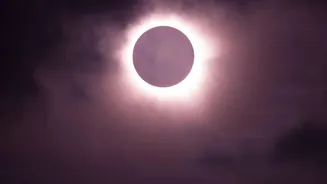
The single most important scientific aspect of a total solar eclipse is the chance to see the Sun's corona, its mysterious, superheated outer atmosphere. Normally, the brilliant surface of the Sun, the photosphere, is so bright that it completely hides
the much fainter corona. During an eclipse, the Moon acts as a natural cosmic shield, blocking the photosphere and allowing the ghostly tendrils of the corona to become visible. This provides a unique window to study its structure and behaviour. While instruments called coronagraphs can simulate an eclipse, they struggle to reveal the innermost region of the corona, where many critical solar processes begin. Natural eclipses offer an unfiltered, complete view that technology cannot yet replicate, making them invaluable for solar physicists.
Solving the Sun's Mysteries
One of the biggest puzzles in astrophysics is the coronal heating problem: the corona is hundreds of times hotter than the Sun's surface, reaching temperatures of a million degrees Celsius, and scientists don't fully understand why. Eclipses allow researchers to gather data on the transfer of heat and energy through this region. Another key area of study is the solar wind, a stream of charged particles that flows from the corona and travels across the solar system. This solar wind is a primary driver of space weather, which can disrupt satellites, power grids, and communication systems on Earth. By observing how material moves from the corona into space during the eclipse, scientists can refine their models for predicting these potentially damaging events.
New Tools for New Discoveries
The 2026 eclipse will be observed with some of the most advanced technology ever deployed for such an event. NASA plans to use its WB-57 high-altitude research aircraft, flying at 50,000 feet to stay above any cloud cover. By chasing the Moon's shadow, the jet can extend the viewing time of totality from just over two minutes on the ground to nearly three minutes in the air. The aircraft will be equipped with a suite of high-resolution cameras capturing images in different wavelengths, helping scientists learn more about the formation of solar prominences and the structure of the corona. Additionally, teams in Iceland will launch dozens of scientific balloons to study how the eclipse's temporary darkness affects Earth's atmosphere, specifically the boundary layer closest to the ground.
Continuing Einstein's Legacy
Solar eclipses have a rich history of landmark discoveries. Famously, the 1919 eclipse provided the first experimental proof of Albert Einstein's theory of general relativity. By observing how the light from distant stars appeared to bend as it passed the Sun's massive gravitational field, Sir Arthur Eddington confirmed Einstein's revolutionary idea that mass curves spacetime. While the theory is now well-established, scientists still use eclipses as opportunities to refine these measurements and test the limits of physics. Each eclipse offers a chance to look for tiny deviations or new phenomena that could point toward an even deeper understanding of gravity and the universe.
Why the 2026 Eclipse is Unique
The path of the 2026 total solar eclipse crosses over Greenland, Iceland, and a large portion of northern Spain, making it the first to be visible in Europe since 1999. This path over populated and accessible land areas provides excellent opportunities for both professional and citizen science projects. Furthermore, since the Sun is constantly changing, every eclipse offers a new snapshot of its activity. Researchers use data from past eclipses to create predictive models of what the corona will look like, and the 2026 event will serve as a crucial reality check for these models, helping to improve our ability to forecast space weather.