






An Earth-Like World, But Not As We Know It
Titan is one of the most intriguing destinations in our solar system. It's the only moon with a thick atmosphere and the only other world besides Earth with stable liquid on its surface. But this isn't a world of water; on Titan, the rivers, lakes, and seas
are filled with liquid methane and ethane. Its bedrock is made of water ice as hard as rock, and its surface temperature hovers around a frigid -179 degrees Celsius. Despite the cold, Titan is a dynamic world. It has a weather system similar to Earth's, but with methane rain instead of water. Its dense atmosphere, mostly nitrogen like our own, is rich in complex organic molecules that rain down onto the surface, forming vast fields of dunes. This unique chemical environment makes Titan a prime target for scientists studying how the building blocks of life form.
Meet Dragonfly: A Revolutionary Explorer
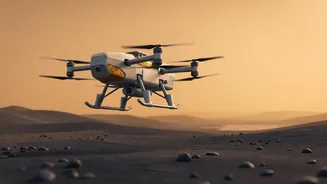
To explore this fascinating world, NASA needed a new kind of vehicle. A stationary lander would be too limited, and a rover would struggle on the varied terrain. The solution is Dragonfly, a dual-quadcopter lander about the size of a small car. With eight rotors, this relocatable science lab will take advantage of Titan's unique conditions. The moon's thick atmosphere—four times denser than Earth's—and low gravity make powered flight an incredibly efficient way to travel. After landing, Dragonfly will spend most of its time on the ground, conducting experiments for about 16 Earth days. Then, it will fly for several miles to a completely new location, a feat that would take a rover much longer to accomplish. This mobility allows Dragonfly to sample dozens of diverse sites, from organic-rich dunes to the floor of an ancient impact crater where liquid water may have once mixed with surface materials.
The Nuclear 'Heart' of the Mission
Titan is about ten times farther from the Sun than Earth, and its thick haze means very little sunlight reaches the surface, making solar power impractical. To operate in this cold, dark environment, Dragonfly will use a Multi-Mission Radioisotope Thermoelectric Generator, or MMRTG. This isn't a nuclear reactor. Instead, the MMRTG uses the steady heat generated by the natural decay of plutonium-238 to produce electricity. This reliable power source will continually recharge Dragonfly's batteries. While the MMRTG provides constant power for instruments and keeping the craft warm, the batteries will provide the high-powered bursts needed for flight. This same type of power system has been successfully used for years on Mars rovers like Curiosity and Perseverance, proving its durability for long-duration space missions.
Searching for the Building Blocks of Life
Dragonfly's primary objective is to investigate prebiotic chemistry—the chemical steps that occurred on Earth before life began. Titan is a natural laboratory for this kind of research, as it's teeming with the same kinds of carbon-based molecules. The lander is equipped with a suite of instruments to analyze this environment. It has drills to collect samples from the surface, which are then fed into a mass spectrometer to identify their chemical composition. Other instruments will measure the elemental makeup of the ground and monitor the weather. By studying different locations, scientists hope to understand how far organic chemistry has progressed on Titan. A key target is Selk Crater, an 80-kilometer-wide impact site where scientists believe liquid water from the impact may have mixed with the surface organics for an extended period, creating a potential primordial soup.
The Long Journey to an Alien Sky
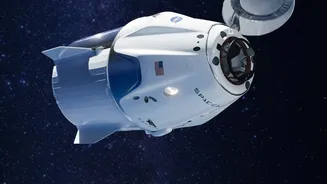
The journey to Titan is a long one. The Dragonfly mission is scheduled to launch aboard a SpaceX Falcon Heavy rocket in July 2028. After a journey of about six years, it is expected to arrive at Titan in 2034. The landing itself will be a major challenge, as the spacecraft must navigate through the thick atmosphere and autonomously select a safe landing spot in the Shangri-La dune sea. Once on the surface, its three-year science mission will begin. Dragonfly represents a new era in planetary exploration, moving beyond stationary landers and slow-moving rovers to a mobile aerial platform that can explore vast regions of another world. It's a bold and ambitious mission that could fundamentally change our understanding of habitability and the potential for life elsewhere in the cosmos.