



What Are These Cosmic Clouds?
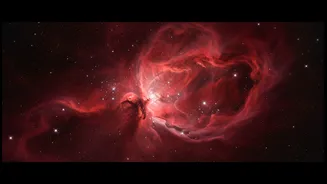
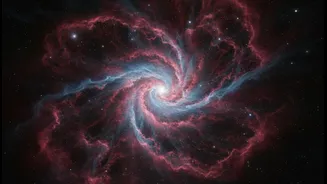
The stunning crimson clouds seen in images of deep space are a type of nebula, specifically known as an emission nebula. A nebula is an enormous cloud of interstellar gas and dust. While some nebulae are dark and only visible because they block light
from stars behind them, emission nebulae create their own light. They are often found in regions where new stars are being born, making them some of the most active and visually spectacular objects in our galaxy and beyond. These stellar nurseries can span hundreds of light-years and are composed mostly of hydrogen, the most abundant element in the universe.
The Science of the Crimson Glow
The signature red colour comes from a specific physical process involving hydrogen gas. Inside these nebulae, massive and incredibly hot young stars emit intense ultraviolet radiation. This high-energy radiation is powerful enough to strip electrons from the surrounding hydrogen atoms, a process called ionization. However, these atoms don't stay ionized for long. The free electrons eventually recombine with the hydrogen nuclei, and as they do, they release their excess energy in the form of light. One of the most prominent wavelengths emitted during this process is a deep-red light known as hydrogen-alpha (or H-alpha), which gives these clouds their characteristic crimson or pink hue.
Stellar Nurseries in Action
These glowing clouds are not just beautiful; they are fundamental to the life cycle of the cosmos. Emission nebulae are stellar nurseries, the very places where new stars are born. Gravity pulls clumps of gas and dust together within the nebula, causing them to collapse and heat up, eventually forming protostars. As these young stars ignite, their radiation begins to illuminate the remaining gas, creating the glowing spectacle we observe. In a recent image from NASA's Hubble Space Telescope, a region called LH 95 was shown to contain around 2,500 young stars that are still gathering mass and have not yet started nuclear fusion. The powerful stellar winds and radiation from the most massive newborn stars also sculpt the surrounding nebula, creating the complex pillars, cavities, and filaments seen in famous images.
Iconic Crimson Landmarks
Some of the most famous objects in the night sky are emission nebulae. The Orion Nebula (M42), visible to the naked eye as a faint smudge in Orion's sword, is one of the closest and most-studied star-forming regions. Another spectacular example is the Carina Nebula (NGC 3372), which is even larger and brighter than Orion but visible primarily from the Southern Hemisphere. It is home to some of the most massive and luminous stars in our galaxy. More recently, the James Webb Space Telescope provided a breathtakingly detailed image of the Rho Ophiuchi cloud complex, the closest star-forming region to Earth, revealing jets of red molecular hydrogen bursting from young stars. These images not only showcase the beauty of these crimson clouds but also provide invaluable data for astronomers studying how stars and planetary systems form.
More Than Just Red
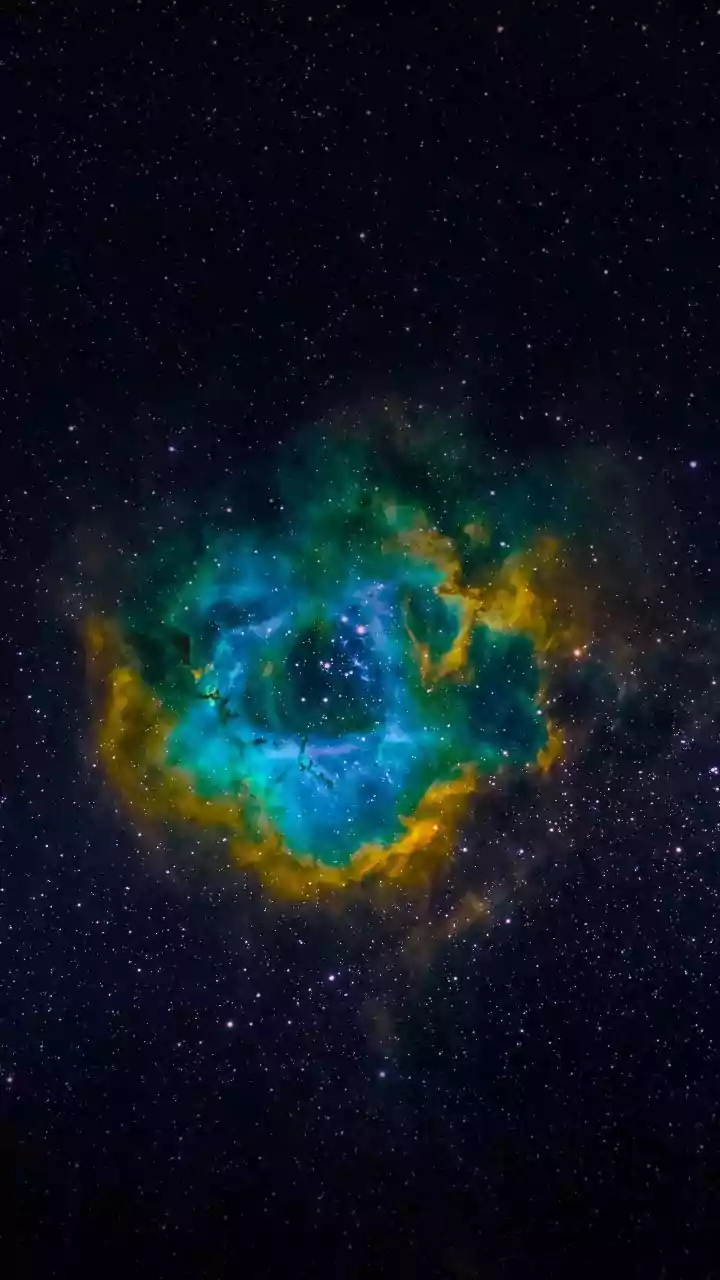
While the red glow of hydrogen is often dominant, it's not the only colour present in these nebulae. Other elements within the gas clouds, such as oxygen and sulfur, can be ionized as well. When these elements emit light, they do so at different wavelengths, producing greens, blues, and other colours. The final colours in an image depend on the chemical composition of the cloud, its temperature, and the types of filters astronomers use to capture the light. For example, ionized oxygen often glows with a distinct green light. This combination of elements is what creates the rich, multi-hued tapestries seen in photographs from space telescopes, turning these distant clouds into cosmic works of art.