



The Challenge of a Fiery Return
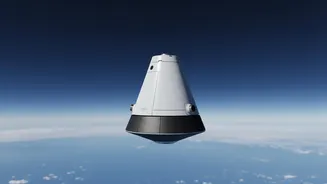
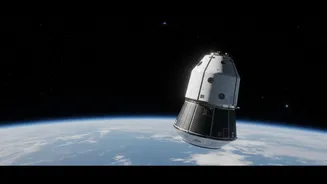
When the Gaganyaan Crew Module returns to Earth, it will be travelling at speeds over 28,000 kilometres per hour. Hitting the atmosphere at this velocity creates immense resistance, compressing the air in front of the capsule and generating temperatures
that can exceed several thousand degrees Celsius. This process must be perfectly controlled. If the re-entry angle is too steep, the capsule could burn up; if it's too shallow, it could skip off the atmosphere and be lost in space. This narrow path is known as the re-entry corridor. ISRO's primary challenge is to slow the capsule from hypersonic speeds to a gentle splashdown, all while protecting the astronauts inside from extreme heat and G-forces. This requires a system that is not just robust, but relentlessly tested and proven to be reliable.
Simulating the Descent with Drop Tests
To validate the systems that protect the capsule, ISRO cannot simply wait for an actual re-entry. Instead, it conducts a series of high-altitude drop tests, officially known as Integrated Main Parachute Airdrop Tests (IMAT). In these exercises, a test article with the same mass and size as the final Gaganyaan Crew Module is lifted to a specific altitude, typically around 2.5 kilometres, by an Indian Air Force heavy-lift aircraft. This module is then dropped to simulate the conditions of the final stage of descent. These tests, often conducted at ranges like the Babina Field Firing Range, are not just about seeing if the parachutes open; they are designed to test the entire sequence under various conditions, including simulated failures.
A Perfectly Choreographed Parachute Dance
The deceleration of the Gaganyaan module is a complex, multi-stage process involving a total of 10 parachutes of different types. The sequence begins long before the main chutes appear. First, two Apex Cover Separation parachutes deploy to jettison the protective cover of the parachute compartment. Immediately after, two Drogue parachutes are deployed. These smaller, more robust chutes are crucial for stabilizing the capsule, preventing it from tumbling uncontrollably, and performing the initial, significant reduction in velocity while it is still travelling at high speed. Only after the drogue chutes have done their job and the module is stable are the main parachutes deployed. Three pilot chutes pull out the three large main parachutes, which are designed to slow the capsule to a safe landing speed for splashdown in the ocean. ISRO has even tested scenarios where one of the three main parachutes fails to open, proving the system's redundancy and ability to land the crew safely even in off-nominal conditions.
Beyond the Drop: Testing Every Critical System
High-altitude tests are just one part of a comprehensive testing campaign. Other critical systems are validated through ground-based simulations. For instance, ISRO has tested the Crew Module Uprighting System (CMUS), an ingenious set of inflatable bags designed to ensure the capsule stays upright after splashing down in the sea, which is crucial for crew recovery. Qualification tests have also been performed on the mechanism that separates the Crew Module from its Service Module before re-entry, ensuring a clean break. Furthermore, engineers have validated the capsule's structural integrity during the pyrotechnic event that ejects the parachute cover, applying forces much greater than those expected in a real mission to confirm its strength. Even the Crew Escape System, designed to pull the crew to safety in case of a launch anomaly, undergoes rigorous high-altitude abort tests using a dedicated Test Vehicle.