




The solar system feels like a permanent, clockwork machine. But scientists are peering billions of years into the future, and new studies suggest the stately dance of the giant planets may end in chaos sooner than we ever thought.
Our Seemingly Stable Backyard
For centuries, we have
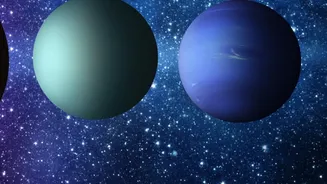
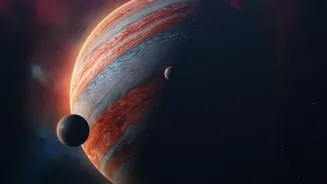
looked to the heavens and seen order. The planets of our solar system, especially the colossal outer worlds—Jupiter, Saturn, Uranus, and Neptune—follow vast, predictable paths around the sun. Their gravitational rhythm has long been considered a model of stability, a cosmic guarantee that our corner of the universe is safe and sound. Scientists like Isaac Newton even pondered the long-term fate of this arrangement, with early calculations suggesting the system was secure. For a long time, it was believed that the orbits of these giants would remain stable for perhaps 100 billion years or even longer, a period that dwarfs the current age of the universe. This perception of celestial permanence, however, is being challenged by new and powerful computer simulations that model the far, far future.
The Science of Cosmic Forecasting
How do you predict the movement of planets over billions of years? You can't just solve a simple equation. The solar system is a 'chaotic' system, meaning tiny, imperceptible nudges between planets can grow into massive changes over immense timescales. To tackle this, astronomers use complex numerical simulations, often called N-body simulations, which run on powerful supercomputers. These models input the current positions and velocities of the planets and then calculate their gravitational interactions step-by-step, far into the future. A recent study published in The Astrophysical Journal Letters did just this, running hundreds of simulations to model the final phases of our sun's life and its effect on the outer planets. These tools allow scientists to test scenarios that are impossible to observe directly, providing a glimpse into the ultimate fate of our cosmic neighbourhood.
A Sun's Messy End
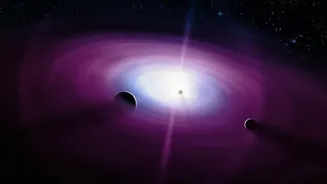
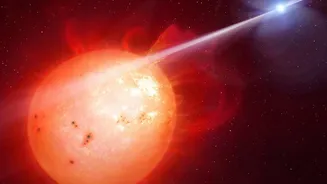
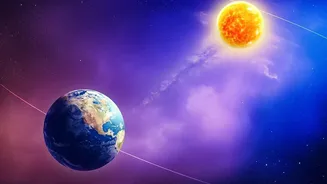
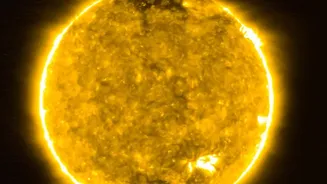
The catalyst for future chaos isn't the planets themselves, but our dying sun. In about five billion years, the sun will exhaust its hydrogen fuel, swell into a red giant, and consume the inner planets, likely including Earth. Afterward, it will collapse into a white dwarf, a dense stellar remnant with about half its original mass. For years, models assumed the sun would lose this mass smoothly. In that scenario, the giant planets would simply drift into wider, but still stable, orbits. However, new research suggests the sun's mass loss won't be a gentle process. Instead, it may happen in a series of random, violent outbursts or 'stochastic shocks'. Each outburst would give the dying sun a tiny gravitational kick, slowly but surely nudging the giant planets and disrupting their delicate gravitational balance.
The Coming Planetary Anarchy
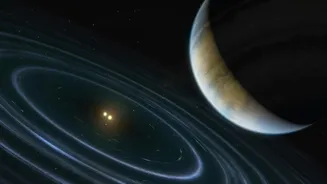
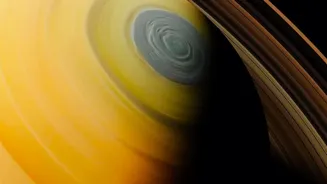
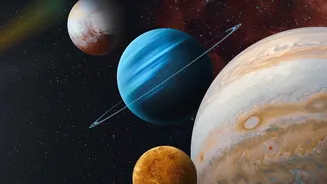
These repeated gravitational nudges from a sputtering sun could trigger widespread orbital disruption a billion times sooner than previously predicted. According to the new simulations, the outer solar system could become unstable within just one billion years of the sun becoming a white dwarf. The results of this instability are dramatic. In some simulated scenarios, the gravitational interplay becomes so chaotic that Saturn is ejected from the solar system entirely. In others, Uranus and Neptune, our distant ice giants, swap places in their orbits. The simulations show that in many cases, the planets are thrown into crossing paths, leading to potential collisions that would destroy them. This paints a picture of a far more violent and unpredictable end for our solar system's giants than the serene, endless dance we once imagined.
So,' Is It Time to Panic?
In a word:', no.' The timescales involved are almost incomprehensibly vast.' The sun's transformation into a red giant is still about five billion years away,' and the subsequent planetary chaos would unfold over the billion years that follow.' Humanity's entire existence is a mere blip on this cosmic calendar.' For all practical purposes,' our solar system is stable and will remain so for any timescale that matters to us.' What these studies provide is not a warning of imminent doom,' but a profound insight into the life cycle of planetary systems.' They show that even the most seemingly permanent structures in the universe are subject to change,' evolution,' and eventual decay.' The findings help us understand the potential architectures of distant solar systems orbiting other white dwarfs and remind us that the cosmos is a dynamic,' not a static,' place.