






Humanity's return to the Moon is about more than just footprints. The Artemis II crew's recent journey yielded a treasure trove of data, including a curious and exciting observation: faint, fleeting flashes of light on the lunar surface.
A Modern Voyage to the Moon
The Artemis II
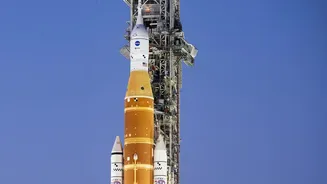
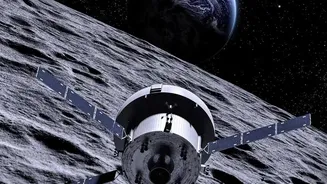
mission, which successfully flew four astronauts around the Moon in April 2026, was a landmark achievement. It was the first time in over 50 years that humans had traveled to our nearest celestial neighbour, paving the way for future landings and a sustained presence. The crew—Commander Reid Wiseman, Pilot Victor Glover, and Mission Specialists Christina Koch and Jeremy Hansen—broke records for the farthest distance humans have traveled from Earth. But beyond the engineering triumph and historic milestones, the mission was a crucial platform for science.
What is a Lunar Impact Flash?
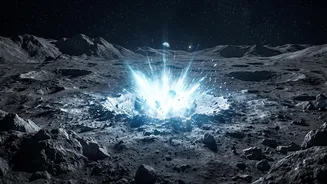
Unlike Earth, the Moon has no significant atmosphere to act as a shield. This means it is constantly bombarded by space rocks, from tiny micrometeoroids the size of a grape to larger asteroids. When one of these projectiles strikes the lunar surface at incredible speed, its kinetic energy is instantly converted into intense heat and light. This creates a 'flash'—not a fire, but a split-second glow from vaporized rock and plasma. Scientists on Earth have been monitoring these flashes for years to understand the frequency and risk of impacts, but observing them from lunar orbit is a rare opportunity.
Pinpricks of Light in the Dark
During a planned observation period while on the far side of the Moon, the crew's watch was rewarded. As the Moon eclipsed the Sun from their perspective, creating ideal dark conditions, astronauts witnessed five distinct 'pinprick' bursts of light. Commander Reid Wiseman was the first to call one out: 'I just saw a flash, 100 percent'. The crew diligently noted the locations on a tablet. After ruling out other sources like cosmic rays or reflections from the spacecraft, NASA's science team confirmed the sightings, which caused excitement in Mission Control. These are likely the faintest impact flashes ever seen by the human eye, possibly caused by meteoroids only a few inches wide.
Why These Flashes Matter
These direct observations are more than just a novelty; they provide a crucial dataset for NASA's long-term lunar ambitions. Understanding how often the Moon gets hit, even by small objects, is essential for assessing the risks to future astronauts, habitats, and infrastructure on the lunar surface. The crew's report from the Moon's far side offers a unique perspective that complements Earth-based and robotic observations. It validates what scientists have long suspected and provides real-world data to refine models of the lunar environment. This information will be critical for planning safe and sustainable missions under the Artemis program.
A Rainbow Moon and Other Discoveries
The impact flashes were just one part of the scientific bounty from Artemis II. The full dataset, totaling over 800 gigabytes, includes thousands of new images and hours of crew audio. The astronauts were also trained to act as field geologists, and their observations are already enhancing our understanding of the Moon. They reported a surprising and subtle palette of colours on the lunar surface—not just grey, but hues of black, brown, tan, green, and blue. These colour variations can help scientists identify different rock and mineral compositions from a new perspective, complementing data from probes like the Lunar Reconnaissance Orbiter.