


The Ultimate Safety Net
At its core, the Gaganyaan Crew Escape System (CES) is the ultimate safety net for the astronauts. Think of it as a sophisticated ejection seat, but for an entire space capsule. Its sole purpose is to pull the crew module—the capsule where the astronauts will
be—away from the launch vehicle in case of a catastrophic failure on the launchpad or during the initial ascent. This system is designed to activate in milliseconds, using powerful, quick-acting solid motors to propel the crew to a safe distance before they parachute back to Earth. For a mission where human lives are at stake, the reliability of the CES is non-negotiable, making its testing one of the most critical phases of the entire Gaganyaan programme.
Two Crucial Scenarios: Pad and In-Flight Aborts
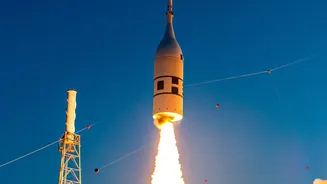
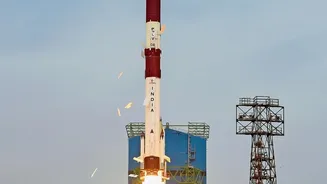
To ensure the Crew Escape System works under all potential emergencies, ISRO is conducting two main types of abort tests. The first is the Pad Abort Test (PAT). This test simulates an emergency while the rocket is still on the launchpad. The first successful PAT was conducted back in July 2018, where the system lifted the capsule to an altitude of 2.7 km before a safe splashdown in the Bay of Bengal. The second, more complex scenario is the In-Flight Abort Test. This demonstrates the system's ability to function during the rocket's ascent, when the vehicle is travelling at high speed and altitude. The first such test, TV-D1, was successfully conducted in October 2023, simulating an abort at a Mach number of 1.2 and an altitude of 17 km. A second test, TV-D2, is scheduled to further validate performance in more complex scenarios.
Testing the Parachutes: The Integrated Air Drop Tests
Whether it's a normal return from orbit or an emergency abort, the crew module must land safely. This is where the parachute system comes in, and it's being validated through a series of Integrated Air Drop Tests (IADT). In these tests, a full-scale crew module mock-up is dropped from a high altitude by an Indian Air Force Chinook helicopter to test the entire parachute deployment sequence. ISRO has planned five such tests to qualify the complex system, which uses ten parachutes of four different types to slow the capsule down for a gentle splashdown. The first IADT was successfully completed in August 2025, with the second following in April 2026. These successful tests confirm the reliability of the multi-stage parachute system, which is designed with redundancy to ensure it works even if a component fails.
Beyond Aborts: Ensuring Post-Landing Safety
Safeguarding the crew doesn't end with a successful splashdown. ISRO is also rigorously testing the systems that ensure astronaut safety after landing in the ocean. In July 2026, ISRO successfully completed three crucial qualification tests. One of these was for the Crew Module Uprighting System (CMUS), which uses inflatable balloons to ensure the capsule stays upright in the water, allowing the crew to exit safely. Other tests validated the mechanism that separates the crew module from its service module before re-entry and confirmed the structural integrity of the apex cover, which protects the parachutes until they are needed. Each of these tests validates a critical step in the chain of events required for a safe mission conclusion.
Paving the Way for India's 'Vyomanauts'
Each successful test is more than just a technical achievement; it's a vital step towards making India the fourth nation in the world to independently send humans into space. The meticulous and repetitive nature of this testing process underscores ISRO's commitment to astronaut safety above all else. Before the first crewed flight, which is targeted for 2027, several uncrewed missions will be conducted. The G1 mission, planned for late 2026, will carry the humanoid robot Vyommitra to test life-support systems in a real space environment. These uncrewed flights, built on the foundation of the successful escape and recovery system tests, will provide the final validation needed to clear the path for India's astronauts, or 'Vyomanauts', to make their historic journey.