







Moving Beyond Basic Grammar Checks
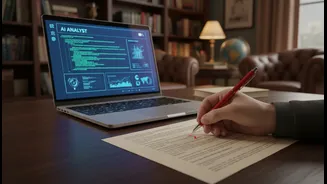
For years, students have relied on software for catching typos and grammatical mistakes. But the new wave of artificial intelligence offers something far more powerful. These tools are no longer just proofreaders; they are becoming analytical partners.
Modern AI can delve into the structure and logic of your writing, helping you see your work from a critical perspective. Instead of just correcting a sentence, it can question the very foundation of a paragraph. This evolution is changing how students can refine their work, moving from surface-level polish to deep, structural improvements that genuinely strengthen their academic writing. The key is to treat AI not as a shortcut to finish an assignment, but as a tool to make the final product intellectually sound.
Your Personal Logical Fallacy Detector
A weak argument often relies on logical fallacies — errors in reasoning that undermine the validity of your claims. These can be hard to spot in your own writing. An AI can be trained to act as a tireless detective, scanning your text for common fallacies like 'straw man' arguments, 'hasty generalisations', or 'slippery slope' reasoning. By pasting a section of your draft and prompting the AI to identify potential logical errors, you get an instant second opinion. Some specialised tools are even designed specifically for this purpose. The AI can highlight a questionable sentence and explain why it might be a fallacy. This doesn't just fix one paper; it teaches you to recognise these flaws, making you a sharper, more critical thinker in the long run.
Finding the Gaps in Your Evidence
A strong argument is built on solid evidence. A common weakness in student papers is making a claim without sufficient support. AI-powered research assistants can help you spot these vulnerabilities. By analysing your draft, these tools can flag assertions that lack a citation or are not adequately backed up by the sources you’ve discussed. You can prompt an AI with questions like, "Which claims in this paragraph need more evidence?" or "Based on my argument, what is the most significant piece of evidence I am missing?" This process helps ensure that every point you make is robust and well-supported, effectively stress-testing your paper before your professor has to.
The Ultimate Stress Test: Generating Counterarguments
One of the best ways to test the strength of your argument is to see how it holds up against opposing views. However, it can be difficult to anticipate every possible counterargument on your own. This is where AI excels as a sparring partner. You can present your thesis and your main points to an AI and ask it to generate strong counterarguments. By prompting it with, "What are the biggest weaknesses in this position?" or "Argue against my thesis," you can uncover blind spots in your reasoning. Engaging with these AI-generated critiques allows you to refine your claims, address potential objections directly in your paper, and build a more nuanced and persuasive case.
Remember: AI Is the Assistant, You Are the Author
With all this power at your fingertips, it’s crucial to remember the most important rule: AI is a tool to enhance your thinking, not replace it. The goal isn't to have an AI fix your paper for you, but to use its feedback to become a better writer and researcher. Always critically evaluate the AI’s suggestions. Does its feedback make sense? Does it align with your research and your own voice? The student must always remain the author, the one who makes the final decisions. Using AI responsibly means staying in the driver’s seat, guiding the tool to help you achieve your own intellectual goals and taking ownership of the final work.