





Ignore the Hype, Read the Ingredients
The most revealing part of any food package is the ingredient list, not the flashy claims on the front. Ingredients are always listed in descending order by weight. If sugar, refined flour (maida), or palm oil are in the top three, that's what the product
is mostly made of, regardless of claims like "high fibre" or "multigrain". The FSSAI is actively issuing notices to companies for making claims like "100% Natural" when the ingredient list shows preservatives and artificial additives. A shorter, more recognizable ingredient list generally indicates a less processed food. Before you trust the marketing, flip the pack and let the true contents guide your decision.
Question Health Buzzwords
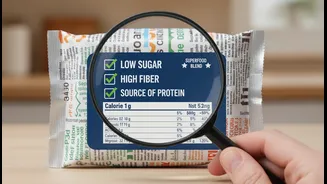
Terms like "natural," "fresh," "pure," "healthy," and "organic" are heavily regulated, and FSSAI has been taking action against brands that use them without meeting strict criteria. For instance, the claim "fresh" cannot be used unless specific conditions are met, and calling a product "healthy" just because it's part of the brand name is considered misleading. Similarly, a product cannot be labelled "100% organic" without prior approval and certification from the authority. Recent FSSAI notices have targeted products making these exact claims without justification. As a consumer, it’s wise to be skeptical of these words and verify them by checking the full ingredient list and nutritional information panel.
Decode the Nutrition Facts Panel
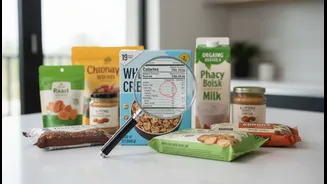
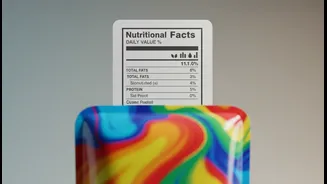
The nutrition panel is your best tool for an objective assessment. To make a fair comparison between products, always use the 'per 100g' column, not the 'per serving' size, which can be misleadingly small. Pay close attention to four key numbers: total sugar, sodium, saturated fat, and trans fat. A food with more than 15g of sugar or 400-600mg of sodium per 100g is generally considered high in those components. Also, check for "partially hydrogenated oils" in the ingredients, which signifies the presence of trans fats even if the label claims "0g trans fat". The FSSAI mandates that all packaged foods display this nutritional information clearly.
Look for Mandatory FSSAI Information
Every legitimate food product must display the FSSAI logo and licence number. This confirms the product is registered with the food safety authority and complies with its regulations. It's a basic check for authenticity and safety. The label must also clearly state the manufacturer's details, the date of manufacture, and the 'best before' or 'use by' date. Another key component is the allergen declaration. FSSAI rules require companies to explicitly mention common allergens like nuts, soy, gluten, and milk. Recently, the regulator has also been cracking down on missing or incorrect allergen information.
Understand Upcoming Changes: Health Stars and Warnings
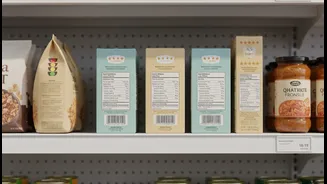
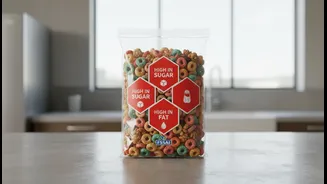
While not fully implemented, FSSAI is moving towards a front-of-pack labelling (FoPL) system, which may include Health Star Ratings (HSR). This system will rate a food from half a star to five stars based on its nutritional profile, particularly its content of salt, sugar, and fat, making it easier to gauge healthiness at a glance. There is also a push, supported by the Supreme Court, for clear warning labels on foods high in these unhealthy ingredients. Although these systems were expected to be introduced voluntarily around 2023 with a four-year transition to becoming mandatory, their final implementation is still under discussion. Being aware of these potential changes will help you adapt as they roll out onto packaging in the coming years.