






The Case of the Disappearing Footprint
To understand why footprints last on the Moon, let’s first think about why they disappear on Earth. When you leave a footprint on a sandy beach or a muddy path, a host of natural forces immediately gets to work erasing it. The most obvious culprit is wind,
which blows loose particles around, smoothing over the impression. Then there's water. Rain can wash away a print in minutes, and even the simple process of evaporation and condensation can alter the soil's structure. Finally, life itself plays a role. Plants grow, insects burrow, and animals trample over the ground, constantly churning the surface. Our planet is dynamic and geologically active, a place of constant change where nothing stays the same for long. This process of erosion is relentless, ensuring that any mark we make is temporary.
A World Without Weather
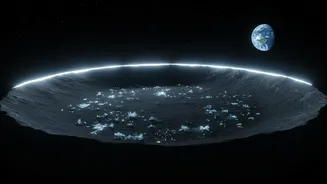
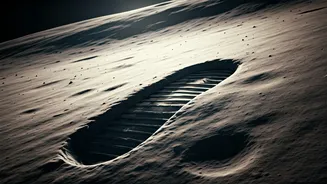
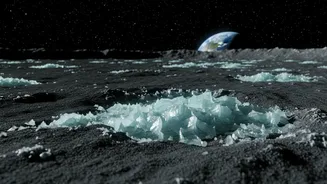
The Moon, in stark contrast, is a world of profound stillness. The “zero” in the headline refers to its most defining feature: a near-total lack of an atmosphere. Without an atmosphere, there is no air, and therefore, no wind to blow dust around. There is no weather system—no clouds, no rain, no snow. The Moon’s water is locked away as ice in permanently shadowed craters at the poles, not flowing freely on the surface. This absence of wind and liquid water means that the two most powerful forces of erosion on Earth simply do not exist on the Moon. When Apollo 11 astronaut Buzz Aldrin pressed his boot into the fine lunar soil, known as regolith, the particles were compacted. With nothing to disturb them, they have remained in that exact position for over half a century. The footprint is essentially a fossil, preserved in a natural vacuum.
The Slow Erasers of Space
So, are the footprints permanent forever? Not exactly. While they are protected from weather, they are not entirely safe from the harsh environment of space. The Moon is constantly bombarded by a gentle but persistent shower of micrometeorites—tiny dust-sized particles travelling at incredible speeds. Each impact, though minuscule, kicks up a tiny bit of lunar dust, acting like a very, very slow form of sandblasting. Over millions of years, this process, known as 'gardening,' will eventually churn the top layer of the regolith and erase the footprints. Another, even subtler force is the solar wind, a stream of charged particles from the Sun that constantly bombards the lunar surface. This also contributes to a very slow erosion. However, the timescale for this erosion is immense. Scientists estimate the footprints will likely remain clearly visible for millions of years, far longer than any structure ever built on Earth.
A Museum in the Sky
This incredible preservation makes the Moon a unique historical and scientific archive. The six Apollo landing sites are essentially pristine archaeological sites from the 20th century. Besides the 12 sets of boot prints, astronauts left behind nearly 100 other items. These include scientific instruments, the American flags (which are likely bleached white by decades of unfiltered solar radiation), lunar rover vehicles, and even personal items like a photograph left by Apollo 16 astronaut Charles Duke of his family. Each item, each footprint, each rover track is a frozen moment in time, telling the story of humanity's first steps away from its home planet. They serve as silent monuments to an extraordinary achievement, preserved not in a museum on Earth, but on the surface of another world.
Preserving a Lunar Legacy
As countries and private companies plan new missions to the Moon, including India's own ambitious lunar programme, a new question arises: how do we protect these historic sites? The return of human activity could inadvertently destroy these precious records. A landing spacecraft could blast the sites with rocket exhaust, wiping the footprints clean. Rovers could drive over them. In response, NASA has established guidelines for future missions, recommending that they keep a safe distance from the Apollo landing zones. These aren't legally binding international laws, but they represent a growing consensus that these sites are part of a shared human heritage. The goal is to ensure that future generations can, perhaps one day, visit these locations and see for themselves the first marks humanity left on another world, still perfectly intact after all this time.