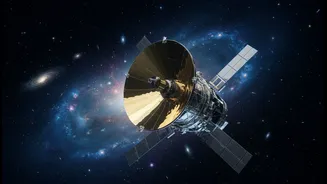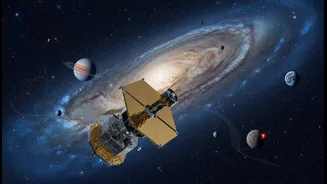



What is the Roman Space Telescope?
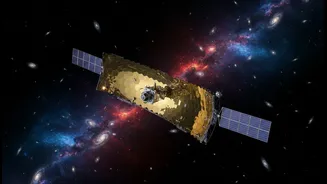
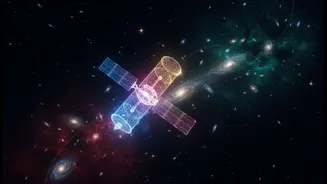
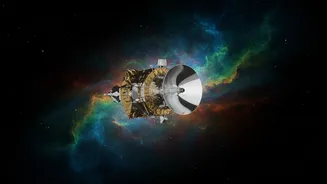
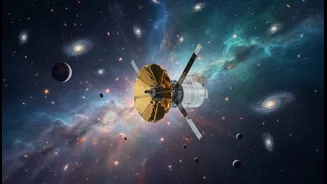
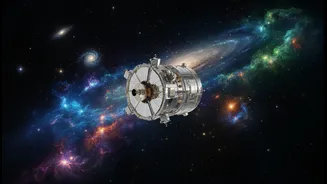
Named after Dr. Nancy Grace Roman, NASA’s first chief of astronomy and the “mother” of the Hubble Space Telescope, this mission is built for discovery on a grand scale. At its heart is a 2.4-metre primary mirror, the same size as Hubble’s, but with a crucial
difference. The Roman Telescope is engineered to see the big picture. While Hubble and the James Webb Space Telescope (JWST) zoom in for incredibly detailed portraits of small celestial patches, Roman will take vast, panoramic shots of the cosmos. It's a survey mission, designed to map huge swathes of the universe quickly and efficiently, gathering an unprecedented amount of data to help scientists understand the universe's structure and evolution.
A Universe in Wide-Screen
Roman's superpower is its Wide Field Instrument (WFI), a 300-megapixel camera that gives it a field of view 100 to 200 times greater than Hubble's infrared camera. Imagine trying to photograph a sprawling landscape. Hubble would take a series of beautiful, high-resolution close-ups of individual trees and rocks that you would have to painstakingly stitch together. Roman, on the other hand, can capture the entire vista in a single, equally sharp photograph. This incredible efficiency means that in its five-year primary mission, Roman will map more of the universe than Hubble has in over three decades. It's this ability to gather massive amounts of data from billions of cosmic objects that makes it a game-changer.
Illuminating the Dark Universe
About 95% of the universe is made of dark matter and dark energy, mysterious substances we cannot see or directly detect. Roman is designed to attack these twin puzzles head-on. To hunt for dark energy, the force thought to be accelerating the universe's expansion, the telescope will conduct enormous galaxy surveys. By precisely measuring the positions and distances of hundreds of millions of galaxies, it will create a 3D map of the cosmos across different eras, allowing scientists to track the history of cosmic expansion with ten times the precision of current methods. For dark matter, Roman will use a phenomenon called gravitational lensing. As light from distant galaxies travels to us, its path is bent by the gravity of intervening matter, including clumps of invisible dark matter. By studying these tiny distortions in the shapes of countless galaxies, astronomers can map the dark matter scaffolding of the universe.
A Census of New Worlds
While Kepler and other missions found thousands of exoplanets, they mostly found worlds orbiting very close to their stars. Roman will complete the planetary census by using a technique called gravitational microlensing, which is sensitive to planets with wider orbits, similar to those in our own solar system. When a star passes almost directly in front of a more distant star, its gravity magnifies the background starlight like a lens. If the foreground star has a planet, the planet’s own gravity creates a brief, additional flicker in the signal. Roman will stare at the dense star fields in the center of our galaxy, monitoring hundreds of millions of stars to catch these fleeting events. This method will allow it to find planets down to the mass of Mars and even free-floating 'rogue' planets that wander the galaxy alone. It's expected to discover thousands of planets, potentially finding more than all other telescopes combined.
Benefits and Strategic Limits
Roman's primary benefit is its sheer statistical power. It will create vast catalogues of galaxies, stars, and exoplanets, providing the data needed to test cosmological theories and understand our place in the galaxy. However, it is a specialized tool, not a replacement for other observatories. Its vision is focused on the visible and near-infrared parts of the spectrum, so it lacks the ultraviolet capability of Hubble or the sensitivity to longer infrared wavelengths of JWST. Its spectrographs are designed for wide, low-resolution surveys, unlike the high-detail instruments on Webb. Roman also carries a Coronagraph Instrument, but this is a technology demonstrator. It will test advanced methods for directly blocking starlight to image nearby planets, paving the way for future missions but not forming a core part of Roman’s primary science goals.