

The Sun’s Constant, Invisible River
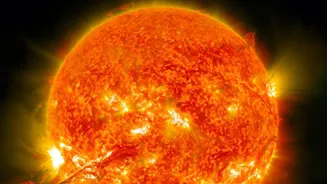
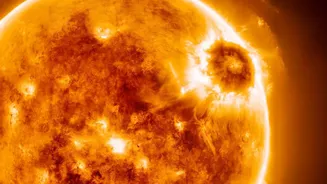
Before diving into the 'how', it's important to understand the 'what'. Solar wind is a continuous outflow of charged particles—mostly electrons and protons—from the Sun's incredibly hot outer atmosphere, the corona. This stream of plasma travels across
the solar system at speeds that can range from a relatively calm 300 kilometres per second to a turbulent 800 kilometres per second or more. While invisible, its effects are profound, influencing everything from the beautiful auroras at the poles to potentially damaging space weather events that can disrupt our technology-dependent lives. Understanding its speed, density, and direction is vital for predicting its impact on Earth.
Aditya-L1's Strategic Vantage Point
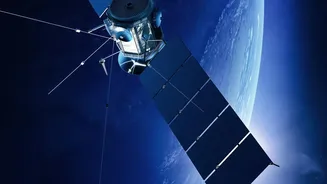
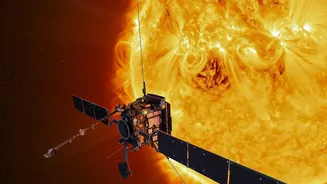
To study this phenomenon without interruption, Aditya-L1 is positioned in a halo orbit around the Sun-Earth Lagrange Point 1 (L1). This unique spot in space, about 1.5 million kilometres from Earth, allows the observatory to have a continuous, uninterrupted view of the Sun. It acts as an early warning post. Since the solar wind travels from the Sun towards Earth, Aditya-L1 can measure its properties about an hour before that same gust of solar wind reaches our planet's magnetic field. This lead time is crucial for preparing our satellite, communication, and power grid systems for potential disruptions.
The Primary Tools: ASPEX and PAPA
Aditya-L1 is equipped with seven sophisticated instruments, but two are the primary detectives for investigating solar wind in-situ, meaning they directly sample the particles flowing past the spacecraft. These are the Aditya Solar wind Particle EXperiment (ASPEX) and the Plasma Analyser Package for Aditya (PAPA). These two payloads work in concert to build a comprehensive picture of the solar wind's characteristics. They don't just measure speed; they analyze the composition, energy, and direction of the particles that make up the wind.
How ASPEX Measures Solar Wind
The ASPEX payload, developed by the Physical Research Laboratory, is designed to study the solar wind's particles to understand their origin and acceleration. It has two main components. The first is the Solar Wind Ion Spectrometer (SWIS), which measures lower-energy ions like protons (hydrogen ions) and alpha particles (helium ions). The second is the Supra Thermal Energetic Particle Spectrometer (STEPS), which focuses on higher-energy particles. By measuring the energy and direction of these incoming ions, SWIS can calculate their velocity. Observing the ratio of alpha particles to protons also gives scientists a key marker to identify the arrival of major solar events like Coronal Mass Ejections (CMEs).
How PAPA Complements the Data
The PAPA instrument, developed by the Vikram Sarabhai Space Centre, acts as a cross-reference, providing further detail on the solar wind's composition. It also has two sensors: the Solar Wind Electron Energy Probe (SWEEP) and the Solar Wind Ion Composition Analyser (SWICAR). While ASPEX focuses heavily on ions, SWEEP measures the energy and flux of electrons in the solar wind. SWICAR, meanwhile, measures the properties of ions, including their temperature and velocity. Together, these instruments provide a robust, multi-faceted data set, allowing scientists to analyze both the electron and ion components of the wind and determine their velocity with high confidence.
From Raw Data to Velocity Patterns
Tracking velocity isn't a single measurement but a continuous process. Both ASPEX and PAPA are designed to measure the direction from which the solar wind particles arrive and their energy. By constantly collecting this data, ISRO's scientists can build up a dynamic map of the solar wind over time. They can identify the arrival of high-speed streams, which often originate from 'coronal holes' on the Sun, and slower, gustier winds associated with CMEs. By correlating this in-situ data with remote observations of the Sun from Aditya-L1's other instruments, like the Solar Ultraviolet Imaging Telescope (SUIT), a complete picture emerges, linking events on the Sun's surface to the wind that arrives at L1. This allows for the identification of recurring patterns and improves the models used for space weather forecasting.